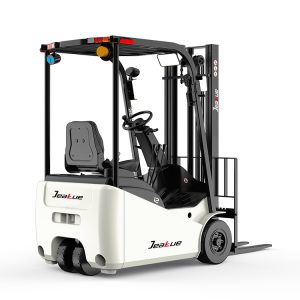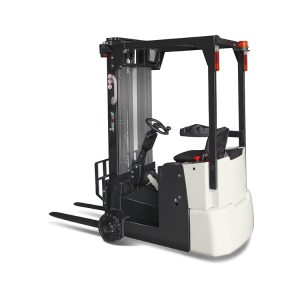
The three wheel counterbalance forklift is a distinctive class of material handling equipment characterized by its unique configuration of two front drive wheels and a single steer wheel at the rear. This tricycle-style design, while seemingly unconventional, offers specific operational advantages that make it an indispensable tool in warehousing and logistics, particularly where space is at a premium. Understanding its mechanics, benefits, and limitations is essential for any operation seeking to optimize its intralogistics.
The defining characteristic of the three wheel counterbalance forklift is its steering geometry. The rear wheel acts as a pivotal point, allowing the vehicle to pivot sharply around obstacles. This design yields an exceptionally tight turning radius, often between 1.4 and 1.8 meters, which translates to superior maneuverability in narrow aisles . Unlike a four wheel forklift, which may require a wider berth to complete a turn, the three wheel model can navigate confined spaces with relative ease, enabling warehouses to utilize their floor space more efficiently by reducing aisle widths.
Beyond maneuverability, the three wheel design offers distinct advantages in terms of operator visibility and maintenance. The absence of a central rear axle and the placement of the single steer wheel directly beneath the counterweight provide the operator with an unobstructed view of the forks and the load during critical lifting and positioning tasks . Furthermore, the simplified rear suspension often results in fewer wear components compared to a four wheel system, potentially lowering long-term maintenance requirements. Many modern electric models leverage dual front drive motors, which not only contribute to the compact turning radius but also allow for precise control and regenerative braking, extending battery life and reducing operating costs .However, the three wheel counterbalance forklift is not without its trade-offs. The most significant limitation is stability, particularly on uneven surfaces. The triangle formed by the three points of contact, while agile, is inherently less stable than the rectangle formed by four wheels . When operating on rough terrain or uneven floors, the forklift is more susceptible to tipping, especially when handling loads at height or during sharp turns. Consequently, these machines are best suited for indoor applications with smooth, level concrete floors. Additionally, the load capacity of three wheel models is generally lower than their four wheel counterparts, typically capping around 2,000 kilograms, as the single steer wheel and rear counterweight must support the fulcrum point of the load .
In conclusion, the three wheel counterbalance forklift is a specialized solution designed for agility rather than brute strength. Its compact footprint and tight turning radius make it ideal for high-density warehousing, retail operations, and distribution centers that prioritize space optimization. While it sacrifices the stability and heavier load capabilities of a four wheel forklift, its performance on smooth indoor surfaces and its contribution to efficient warehouse layout design remain unmatched. For operations where narrow aisles and rapid pallet movement are the norm, the three wheel counterbalance forklift stands as a highly effective and efficient tool.