When the temperature drops to -20°C or lower, most industrial machinery begins to protest. In the world of cold storage and food logistics, however, keeping the supply chain moving isn’t a luxury—it is a necessity. Frozen goods, ice cream, and perishable medical supplies wait for no one, and every minute of forklift downtime risks thousands in product loss.
This is the battleground where JEAKUE lead-acid forklifts prove their mettle. While lithium-ion batteries often grab headlines, the rugged reliability and cost-effectiveness of modern lead-acid technology, particularly when optimized for extreme environments, remain unmatched for many operators. Here is the technical playbook for maximizing uptime with JEAKUE forklifts in the harshest freezers.
The Cold Reality: Why Batteries Struggle
To win the war against downtime, you must first understand the enemy: physics.
Cold temperatures dramatically alter battery chemistry. In a standard lead-acid battery operating at 0°C, you have already lost approximately 20% of your available capacity. At -20°C, a lead-acid battery operating without proper thermal management retains barely 55% of its rated capacity .
When you combine this natural capacity loss with the increased density of cold air (requiring more fan power for motor cooling) and thicker hydraulic oils, the standard forklift becomes a slow, sluggish shadow of its warm-warehouse self. However, JEAKUE’s engineering approach specifically tackles these issues through robust construction and smarter maintenance protocols.
JEAKUE’s Built-In Advantages for the Freezer
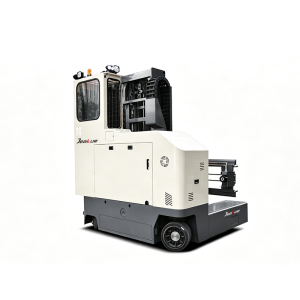
JEAKUE forklifts, such as the FB series (1.5-2T models), are designed with the realities of industrial use in mind. While many retrofitted trucks fail when the mercury drops, JEAKUE units utilize AC ZAPI control technology . This drive control system offers superior performance in high-torque, low-speed scenarios typical of congested cold stores.
Furthermore, the standard fitment of semi- or solid-elastic tires (e.g., 18×7-8 sizes) provides the necessary grip on icy, slippery concrete without the flat risk of pneumatics . To maximize uptime, we leverage these mechanical strengths and optimize the battery strategy.
Strategy 1: The “Warm Swap” Rotation System
Because lead-acid batteries lose capacity in the cold and cannot be fast-charged in sub-zero temperatures without risking internal damage (lithium plating or crystallization), the most effective strategy is rotating pre-warmed batteries .
The Procedure:
-
Never charge a freezing battery. If the electrolyte drops to -10°C or below, do not plug it in. Charging a frozen battery can cause the case to rupture or suffer irreversible crystallization damage .
-
Establish a “Warm Room.” Invest in a small, insulated charging room maintained at 10-25°C .
-
The 3-Battery Cycle: For a 24/7 cold store operation, utilize three batteries per truck. One is in the truck working, one is charged and warming in the room, and one is cooling down after charging.
JEAKUE models support battery capacities up to 600Ah (48V) , allowing for extended shifts when starting with a fully warmed, 100% charged battery .
Strategy 2: The Preventive Maintenance Checklist (SOP)
Cold storage has a unique ability to destroy machinery through condensation. When a warm JEAKUE forklift (coming from the charging room) enters a -25°C freezer, moisture condenses on every circuit board, cable, and hydraulic fitting.
To maximize uptime, your SOP must include:
-
Hydraulic Fluid Viscosity: Standard hydraulic oil turns to molasses in the cold. You must switch to low-temperature hydraulic oil (like ISO VG 32 or VG 46 low-temperature grade) with a pour point ≤ -25°C to prevent pump cavitation .
-
The “Glide” Pre-Heat: Before applying a heavy load, perform 5-10 minutes of no-load operation (lifting/lowering the forks) to circulate and warm the hydraulic oil .
-
Anti-Corrosion Protocol: Weekly, clean the battery terminals with a solution of baking soda and water to neutralize acid creepage. Apply anti-corrosion gel to the terminals immediately after . Creepage currents are prevalent in the humidity of cold stores.
Strategy 3: Mastering the Charge Profile
Standard battery chargers are “dumb” regarding temperature. They rely on voltage readings. However, a cold battery shows artificially high voltage, tricking the charger into undercharging.
To maximize the lifespan of your JEAKUE lead-acid batteries:
-
Use Temperature Compensation: Ensure your charger has a temperature sensor or probe. It must increase the charge voltage by approximately 3mV per cell per degree Celsius below 20°C to push a proper charge into a cold battery .
-
Equalize Monthly: In cold storage, batteries rarely get a perfect, complete saturation charge. Perform an equalizing charge (a controlled overcharge) every week or two to stir the electrolyte and prevent acid stratification .
Safety & Operational Efficiency
Finally, uptime depends on the driver. A shivering operator makes mistakes and takes breaks, costing productivity.
While JEAKUE units are robust, ergonomics matter. Ensure that the overhead guard (2060mm on FB series) provides adequate clearance for winter gear and that the controls are glove-friendly . If the truck operates in “deep freeze” (below -18°C), consider a heated cabin to keep the operator warm and the electronics functioning optimally .
Conclusion
You don’t necessarily need to spend a fortune switching your entire fleet to lithium-ion to conquer the cold. By utilizing JEAKUE’s durable chassis and AC power technology combined with strict “Warm Swap” battery protocols, low-temperature hydraulics, and smart charging habits, your lead-acid fleet can achieve near-100% uptime.
The cold chain doesn’t have to be a weak link. With JEAKUE and a disciplined maintenance routine, you ensure that the only thing frozen in your warehouse is the inventory, not your productivity.
Disclaimer: Specifications for JEAKUE models (FB15, FB18, FB20) are based on manufacturer data. Always consult your specific equipment manual for cold storage conversion kits and low-temperature fluid requirements .