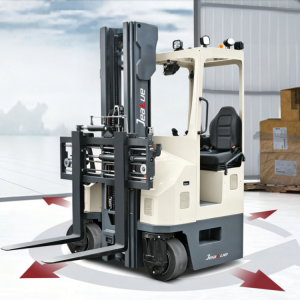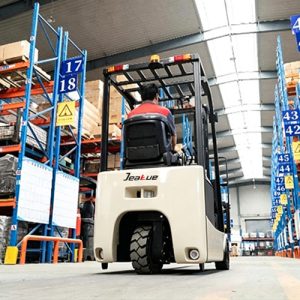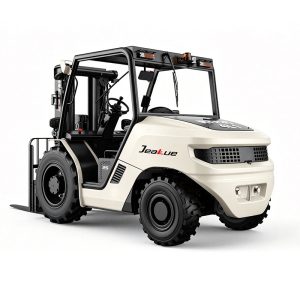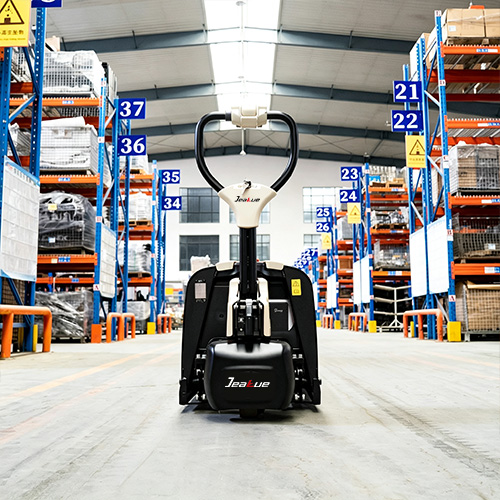
As land costs rise and supply chains demand ever-greater efficiency, warehouses are building upward. The high lift reach electric truck has emerged as the critical equipment enabling this vertical expansion, combining narrow-aisle maneuverability with lifting heights that were unimaginable for forklifts just a decade ago. These machines are no longer simple load movers; they are precision instruments engineered to maximize storage density while minimizing operational footprint.
The defining characteristic of a high lift reach electric truck is its ability to access racking at extreme heights. Modern models from leading manufacturers now routinely achieve lift heights of 12 to 14 meters. Jungheinrich’s ETV 4i, for instance, reaches up to 14 meters with load capacities between 1.4 and 2.5 tonnes . Raymond’s Deep-Reach 7530 model extends to 13,767 millimeters, specifically designed for double-deep pallet storage that doubles storage density without widening aisles . EP Equipment’s CQD25RVF offers a 12.5-meter lift while maintaining full rated capacity of 2,500 kilograms up to 6.5 meters, a critical distinction because usable capacity diminishes as mast height increases . This nuance matters: buyers who select a truck solely on maximum height without checking residual capacity at the top rack level risk unsafe or inefficient operations .
Performance at height is not merely about reaching the shelf; it is about cycle time. The latest generation of reach trucks has dramatically improved lift and lowering speeds. Jungheinrich’s liftPRO function doubles lifting speed to 1.5 meters per second unloaded, while loweringPRO achieves 1.2 meters per second, reducing the time operators spend waiting for forks to travel . In multi-shift distribution centers where seconds per pallet compound into hours per week, these gains directly affect throughput and labor costs.
Electric powertrains are intrinsic to this category, and lithium-ion technology has accelerated adoption. Integrated Li-ion batteries enable opportunity charging during breaks, eliminating the battery swaps and long charging cycles associated with lead-acid systems . This flexibility keeps trucks available across 20-hour operating schedules. Moreover, the elimination of bulky battery trays has improved visibility through the mast, a safety advantage in narrow aisles where operators must judge fork position several stories above the floor .
Safety and stability systems have evolved alongside lift heights. Modern high lift reach trucks incorporate speed reduction at elevated mast positions, load-height monitoring, fork cameras, and clear-view mast designs . These features support operators in what remains a demanding task: placing a pallet precisely into a racking bay while positioned at ground level, with limited depth perception.
The high lift reach electric truck represents a convergence of spatial efficiency, energy flexibility, and precision engineering. For warehouses constrained by real estate costs and labor availability, these machines are not optional upgrades but foundational assets. As racking systems grow taller and order profiles become more fragmented, the reach truck’s role will only expand, pushing manufacturers toward even greater heights and smarter integration with warehouse management systems.