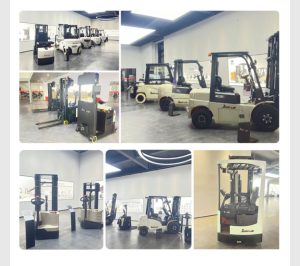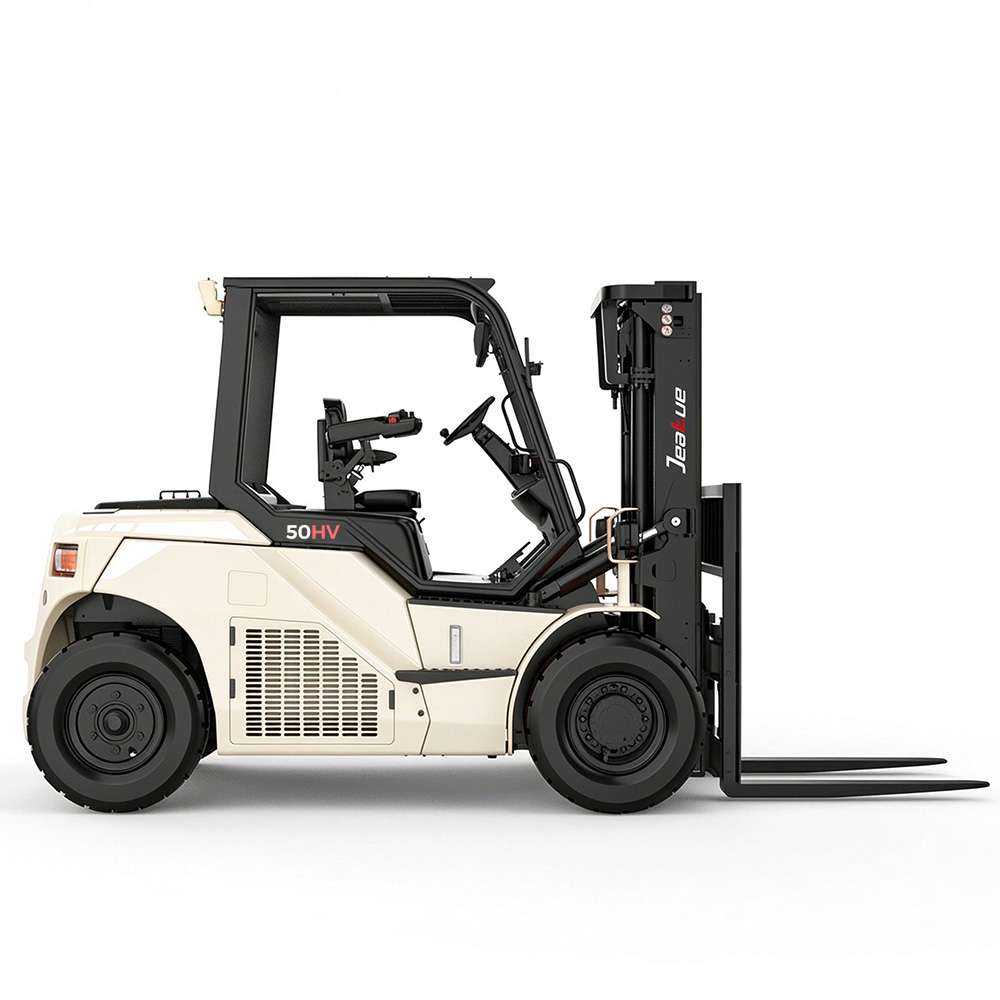
China has become the undisputed global manufacturing hub for four-wheel electric forklifts, combining mature AC drive technology, increasingly affordable lithium-ion batteries, and a dense supply chain that spans from Hebei assembly plants to Zhejiang component clusters. For buyers worldwide, the Chinese four-wheel electric forklift represents a compelling balance of capability, price, and rapidly improving technical sophistication.
The typical Chinese four-wheel electric counterbalance forklift covers a rated capacity of 1 to 5 tons, with 2-ton and 3-ton models dominating export volumes. A representative CPD20 unit from a Hebei manufacturer pairs a 5.5 kW drive motor with a matching lift motor, rides on solid tires, and offers a standard lift height of 3000 mm, extensible to 5000 mm or more . Larger 3-ton variants step up to 8.5 kW motors while maintaining the same 1200 mm body width, keeping the machines viable in moderately narrow aisles . Prices for entry-level 2-ton models start around $3,500, though specifications and battery chemistry swing costs considerably .
The defining shift in recent years has been the migration from lead-acid to lithium iron phosphate batteries. Chinese manufacturers now offer lithium options across nearly every model line, promising two-hour full charges, five-year or 10,000-hour battery warranties, and the elimination of watering and equalization routines . This matters for multi-shift operations: opportunity charging during breaks can keep a forklift running through a full working day without a battery swap. Domestic battery giants like BYD have leveraged their cell technology to position lithium forklifts as a lifecycle-cost play rather than just an environmental gesture .
China’s forklift industry is not a monolith of budget clones. Anhui Heli and Hangcha Group together command roughly half the domestic market and have built reputations for full-spectrum product lines, extensive dealer networks, and significant patent portfolios . Heli holds more than 25% market share and has led domestic sales for over three decades; Hangcha invests around 4.2% of revenue into R&D and has pushed aggressively into AGV-integrated logistics . Below these giants, a tier of specialized players—Noblelift in light warehouse equipment, Zhongli with its “Little Diamond” series for e-commerce fulfillment, and Longking in heavier counterbalance trucks—fills out a diverse and competitive landscape .
For international buyers, the practical considerations are straightforward. Chinese four-wheel electric forklifts meet CE requirements for export markets, and SGS or BV audits are common among established suppliers . Customization is widely available, from paint color and branding to mast specifications and attachment compatibility. The main caution is due diligence: quality varies enormously across the thousands of registered manufacturers, and the cheapest quote often reflects thinner steel, lower-grade controllers, or abbreviated testing. Buyers who specify reputable motor and controller brands, verify battery cell provenance, and insist on pre-shipment inspection reports tend to get machines that rival established Western brands at 40 to 60 percent of the price.
The trajectory is clear. As Chinese suppliers refine their lithium platforms, integrate telematics, and expand overseas parts depots, the four-wheel electric forklift from China is moving from a price-driven alternative to a genuinely competitive first choice for warehouses and factories worldwide.