In modern warehousing and logistics, the separation of material handling from weighing processes has long represented a hidden inefficiency. Operators must transport pallets to a fixed floor scale, wait for a reading, and then continue to their destination—a workflow that consumes time, occupies floor space, and introduces unnecessary traffic. The electric pallet truck with an integrated scale eliminates this bottleneck by combining powered movement with precise on-board weighing. This hybrid equipment allows goods to be weighed at the point of lift, transforming a routine transport task into a simultaneous data-capture event.
How Integrated Weighing Works
Unlike manual pallet trucks fitted with basic weighing devices, electric models with integrated scales rely on load cells embedded within the fork structure. Most systems employ four shear-beam load cells, often rated IP67 for protection against dust and moisture, to measure the load as it is lifted . The weight indicator—typically mounted on the tiller head or a dedicated console—displays gross, tare, and net weights with accuracy levels commonly around ±0.1% of the applied load . This precision is sufficient for goods receipt verification, shipping weight confirmation, and stock control without requiring a separate certified scale for internal purposes.
The integration extends beyond simple weight display. Higher-tier models offer accumulation functions for totalling multiple pallets, piece counting, and optional thermal printers that generate time-stamped weight tickets . Connectivity via Bluetooth or Wi-Fi enables direct transmission to warehouse management systems, reducing manual data entry errors and accelerating documentation workflows .
Operational Advantages in Practice
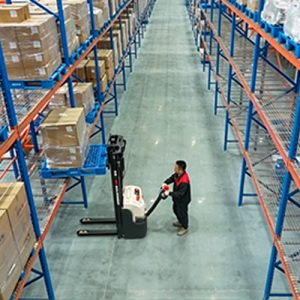
The most immediate benefit is temporal. A single operator can lift, weigh, and move a pallet in one continuous motion. In receiving areas, this means incoming shipments can be verified against packing lists without diverting to a fixed scale. In outbound operations, shipping weights can be confirmed before the pallet reaches the loading dock, preventing costly overweight penalties or under-shipment disputes . The elimination of extra trips also reduces forklift and pedestrian traffic in aisles, contributing to safer warehouse environments.
Electric drive adds another layer of efficiency. Powered travel and lifting reduce operator fatigue compared to manual pump trucks, particularly in high-throughput facilities where dozens of pallets are moved per shift. Lithium-ion batteries, common in newer models, support opportunity charging during breaks, ensuring the truck remains available across extended shifts . Speed reduction systems that automatically slow the truck during turns further enhance safety when carrying loads that may be heavier than anticipated—an important consideration given that the scale itself serves as an overload warning system on certain models .
Selection Considerations
Capacity requirements vary by application. Common electric models range from 1,200 kg to 1,500 kg, with some reaching 2,000 kg or more . Buyers should match capacity to the heaviest loads expected while accounting for the weight of the pallet itself. Accuracy specifications matter for compliance: operations where weight determines billing may require trade-approved scales with verified calibration, while internal stock control can tolerate standard industrial accuracy.
The working environment also dictates specifications. Cold storage, wash-down areas, and outdoor loading docks demand higher IP ratings and corrosion-resistant construction. For facilities using Euro pallets exclusively, fork dimensions of approximately 1,150 mm by 550 mm are standard, but non-standard pallet sizes may require custom fork configurations . Finally, data integration capability should align with existing systems: a basic display suffices for simple verification, while WMS-connected models justify their premium through reduced administrative labor and improved inventory accuracy.
Conclusion
The electric pallet truck with scale represents a practical convergence of two functions that have historically occupied separate steps in the supply chain. By weighing goods at the moment of lift, it removes a recurring friction point from warehouse operations while preserving the maneuverability and lifting performance expected of a powered pallet truck. For facilities processing sufficient volume to justify the investment, the payback comes not from replacing a floor scale, but from eliminating the time, traffic, and paperwork that separate handling from measurement.