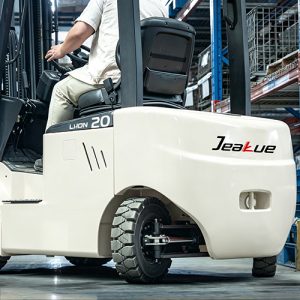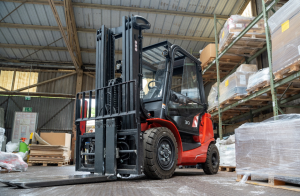
In modern warehousing and manufacturing, space comes at a premium. Conventional counterbalanced forklifts typically require aisles of 10 to 12 feet to operate effectively . For operations handling long, bulky materials, this represents a significant loss of valuable storage capacity. The narrow aisle side loader solves this problem by fundamentally rethinking how loads are picked up and transported.
What Is a Narrow Aisle Side Loader?
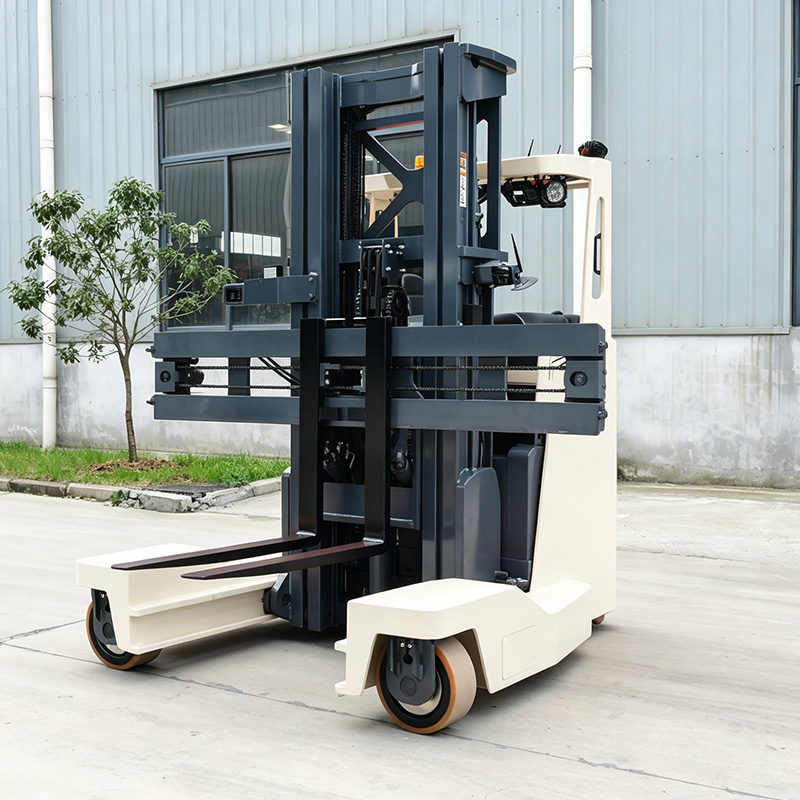
A side loader is a specialized industrial truck that lifts loads from the side rather than from the front . This simple difference in orientation has profound implications for warehouse efficiency. By picking up long materials such as timber, steel pipes, or plywood sheets parallel to the direction of travel, side loaders can operate in aisles as narrow as 5 to 6 feet .
This design makes side loaders a type of Very Narrow Aisle or VNA forklift, a category that also includes articulated mast forklifts and turret trucks . The defining characteristic is the ability to handle materials that would be awkward or unsafe to transport with a traditional forklift.
Multidirectional Maneuverability
The most advanced narrow aisle side loaders feature multidirectional steering systems. These trucks can travel forward, backward, sideways, and diagonally, allowing them to transition seamlessly between travel modes . This capability is particularly valuable when navigating tight racking systems or feeding machine tools.
Patent documentation for early sideloader designs describes the mechanical principles underlying this versatility. The load-side wheels can index 90 degrees to the direction of travel, enabling lateral movement while the forks remain positioned for side loading . Modern implementations use advanced hydraulic or electric systems to achieve the same effect with greater precision and operator control.
Space Utilization Benefits
The primary advantage of narrow aisle side loaders is their contribution to storage density. Because the load is carried on the truck‘s platform rather than extending forward, side loaders require significantly less aisle space than conventional forklifts . This can improve space utilization by as much as 100 percent or more .
For industries handling long goods, this benefit is transformative. A timber merchant, for example, can store far more inventory in the same building footprint. A steel fabricator can access bar stock more efficiently while allocating more floor space to production equipment.
Real-World Applications
A recent case study illustrates the practical impact of these machines. Lamiplast, a Spanish building materials supplier, implemented a HUBTEX PHOENIX multidirectional electric sideloader after a storm destroyed most of its existing handling equipment . The company needed to store goods up to 6 meters long in narrow aisles while maximizing vertical storage capacity.
The solution provided automatic aisle detection using ultrasonic sensors, which instantly aligns the wheels when entering an aisle. This increases safety, reduces unnecessary maneuvers, and speeds up high-level handling . According to the operator, the new machine is “very digital, very smooth, and allows you to do things that other trucks simply can’t” .
Safety and Efficiency Considerations
Narrow aisle side loaders incorporate several safety features appropriate for their operating environment. For high-lift applications, speed reduction systems automatically limit travel and maneuvering speeds when the mast exceeds a certain height . This protects operators and goods by preventing abrupt movements at elevation.
Modern electric sideloaders offer additional advantages. They produce zero emissions, making them suitable for indoor use in enclosed warehouse spaces . Battery technology supports full-shift operation on a single charge, with some models achieving 8 to 10 hours of runtime .
Conclusion
The narrow aisle side loader represents a specialized but essential solution for industries handling long, bulky materials. By reorienting the loading direction and incorporating multidirectional travel capabilities, these machines unlock storage capacity that conventional forklifts simply cannot access. As warehouse space becomes increasingly valuable, the side loader‘s ability to operate in aisles as narrow as 5 to 6 feet will continue to make it an attractive investment for timber, steel, and building materials operations.