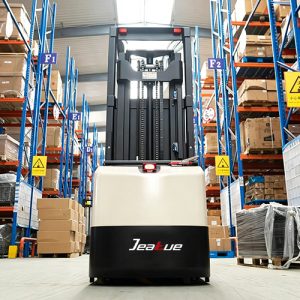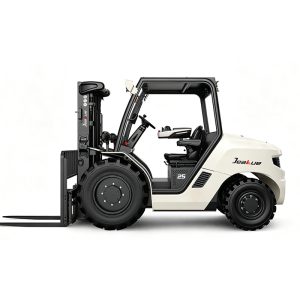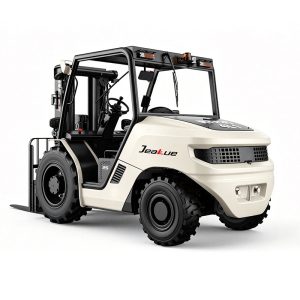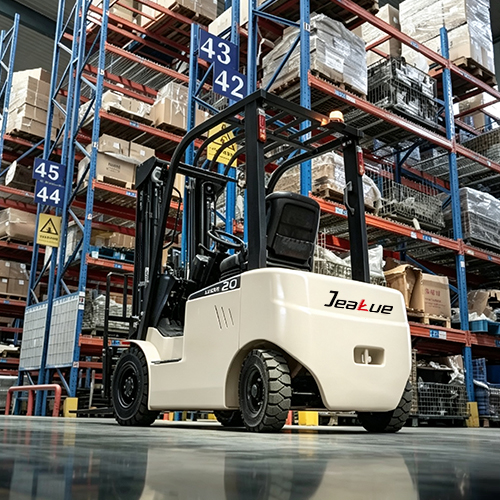
In the modern warehouse, efficiency is not merely a goal; it is the currency of survival. As real estate costs soar and consumer demand for rapid fulfillment intensifies, logistics managers are forced to think vertically. The race is on to build higher, store denser, and move faster. However, in this pursuit of optimization, a fundamental engineering truth is often overlooked until it is too late: the forklift and the racking are not separate assets; they are a single, interdependent system.
When a warehouse is designed, the specification of the forklift fleet and the layout of the aisle racking must be developed in lockstep. Failure to align these two elements results in a cascade of inefficiencies—from wasted cubic footage and damaged inventory to catastrophic structural failures and crushing downtime. Understanding this synergy is the difference between a warehouse that operates and one that competes.
1. The Geometry of Space: Aisle Width and Turning Radius
The most immediate and visible intersection of forklift and racking lies in the aisle width. This dimension is dictated almost entirely by the truck’s turning radius and maneuverability.
-
The Counterbalance Conundrum: Traditional sit-down counterbalance forklifts require significant turning radiuses. To accommodate them, warehouses must allocate wide aisles—often exceeding 12 to 14 feet. While these trucks are versatile, they waste vast amounts of square footage that could otherwise be used for pallet positions.
-
The VNA Revolution: Conversely, Very Narrow Aisle (VNA) trucks, such as turret trucks or swing-reach trucks, are specifically engineered to operate in aisles as narrow as 5 to 6 feet. However, these trucks require specialized guidance systems (rail or wire) and flat, level floors to function.
The Synergy: If you purchase a VNA truck without preparing the floor and racking for rail guidance, you have wasted the capital investment. Conversely, if you design narrow aisles but purchase standard counterbalance trucks, you render the racking inaccessible. The specification of the truck dictates the physical maximum density of the racking layout.
2. Vertical Reach and Rack Height
The “height” capacity of a forklift must precisely match the “top beam” height of the racking system. While this seems obvious, the nuance lies in the “lift-off” height and mast deflection.
-
Mast Deflection: At maximum elevation, a fully extended mast can sway significantly. If the racking is high and the uprights are not reinforced, or if the truck lacks a stabilizing “mast tilt” system, the operator may struggle to insert the pallet into the beam.
-
Tilt and Shift: The carriage must have sufficient tilt and side-shift capabilities to compensate for pallet warpage and rack beam variances.
The Synergy: Specifying a 40-foot rack requires a truck capable of 42-foot lift height to allow for floor clearance and safe placement. However, at that height, only wire-guided VNA trucks with stabilizing outriggers can achieve the necessary precision. Choosing the wrong truck for the rack height leads to product damage and safety cage impacts that can compromise the structural integrity of the entire building.
3. The Weight Balancing Act: Capacity at Height
A forklift’s load capacity is not static; it diminishes dramatically as the load is elevated. This is a function of the “load center” and the truck’s fulcrum.
-
De-rating: A forklift rated at 5,000 lbs at a 24-inch load center may only safely handle 3,500 lbs when lifted to 30 feet.
-
Rack Beam Capacity: Similarly, rack beams are rated for uniform load distribution.
The Synergy: The warehouse designer must cross-reference the “capacity at elevation” chart of the forklift with the “maximum payload per level” of the racking. If the forklift’s lifting capacity at height exceeds the rack’s beam capacity, the operator could inadvertently place a load that collapses the racking. Conversely, if the forklift cannot lift the max load to the top tier, that high-density racking becomes obsolete. The specifications must be harmonized to ensure that what the truck can lift is exactly what the rack can hold—neither more nor less.
4. Battery Technology and Operational Throughput
The synergy extends into the digital realm of energy management. Racking configuration influences travel distance, which influences battery consumption.
-
High-Density Racking often means longer travel distances to the back of the deep lane.
-
Lithium-Ion vs. Lead-Acid: If you opt for high-density racking that requires long, constant travel and high lifting cycles, a standard lead-acid battery may require changing mid-shift. This downtime kills throughput.
The Synergy: Specifying the battery and charger infrastructure must align with the racking layout. If the racking is designed for “batch picking” in deep lanes, the forklift must have the “opportunity charging” capability (Lithium-Ion) to keep moving without swapping batteries on the floor. If you choose cheap lead-acid batteries for a high-throughput, narrow-aisle system, you will create a bottleneck at the charging station that no amount of racking optimization can solve.
5. The Data Layer: Fleet Management and Inventory Accuracy
Modern racking systems are often integrated with Warehouse Management Systems (WMS) that direct operators to specific bay locations. However, the forklift must be able to “talk” to that WMS.
-
RFID and Laser Guidance: A truck equipped with laser height indicators can automatically direct the operator to the correct level of the racking, reducing human error.
-
Impact Detection: Telematics can record impacts with racking uprights. While a rack might survive a minor bump, repeated impacts (caused by trucks that are too large for the aisle) weaken the steel.
The Synergy: Data from the forklift acts as the diagnostic tool for the racking health. The technology specifications of the forklift must be advanced enough to provide this feedback loop. Without this synergy, you are flying blind—unaware that your racking is slowly being damaged by the very trucks designed to service it.
Conclusion: The Unified Design Principle
The days of selecting a forklift from a catalog and a racking system from a separate spreadsheet are over. The modern warehouse demands a “systems approach” to engineering. The floor load, the aisle width, the upright gauge, the mast height, the battery chemistry, and the software protocols—these are all threads of the same fabric.
When these specifications synergize, the result is a warehouse that maximizes cubic utilization, reduces energy consumption, and guarantees safety. When they diverge, you are left with a costly mismatch: a high-bay racking system that your trucks cannot serve, or a high-performance truck that is suffocated by tight corridors.
The math is unforgiving: a 1% loss in efficiency due to mismatched specifications can cost thousands of dollars annually in labor and wasted space. Therefore, before laying the first beam or ordering the first truck, integrate your engineering teams. The racking and the forklift must be designed together, because in the physics of logistics, they are inseparable.