Introduction
In modern warehousing and logistics operations, the efficient movement of materials across long distances is a critical factor in maintaining productivity. While forklifts excel at lifting and stacking, they are not optimized for horizontal transport over extended runs. This is where the towing tractor—also known as a tow tractor, tugger, or tow tug—becomes indispensable. A towing tractor is a specialized piece of material handling equipment designed to pull wheeled carts, trailers, or trains of loads through a facility, enabling fewer trips and streamlined workflow.
This article examines the role of towing tractors in warehouse environments, explores the key types and capacities available, and provides practical guidance for selecting the right equipment for specific operational needs.
What Is a Warehouse Towing Tractor?
A towing tractor is a powered vehicle that connects to and pulls loads rather than lifting them. Unlike a forklift, which raises pallets for stacking, a tow tractor is engineered for horizontal transport—moving materials from receiving docks to storage areas, from picking zones to shipping, or along assembly lines. By towing multiple carts or trailers in a single trip, these machines significantly reduce the number of individual movements required, optimizing labor and time.
Modern tow tractors are predominantly electric, powered by lead-acid or lithium-ion batteries. This makes them ideal for indoor warehouse use, as they produce zero emissions and operate with minimal noise. They are also highly maneuverable, with compact models designed for narrow aisles and tight spaces, while heavy-duty variants can handle substantial loads.
Types and Configurations
Towing tractors for warehouse applications come in several configurations, each suited to different operational requirements.
Walk-behind or pedestrian models represent the compact end of the spectrum. These units are guided by an operator walking alongside or behind the machine, making them ideal for tight spaces and occasional use. Capacities typically range from 0.4 tonnes to 3 tonnes, with some models capable of pulling up to 3,000 kilograms. Their small footprint and simple operation make them accessible for retail back-of-house, light manufacturing, and smaller warehouse operations.
Stand-on models allow the operator to ride on a platform, improving comfort and speed for longer runs while maintaining excellent visibility. The Linde P20, for example, features a particularly slim design for narrow aisles and offers an optional folding seat for longer journeys, towing up to 2 tonnes. Toyota’s stand-on CB series can handle between 8,800 and 13,200 pounds, with a tight turning radius suited to cramped, busy work environments.
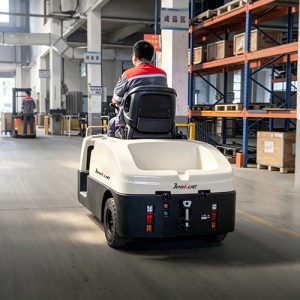
Sit-down models are designed for maximum operator comfort during extended shifts and long-distance transport. These tractors resemble small trucks and can achieve travel speeds of up to 11.2 MPH or more. They are commonly used in large distribution centers, manufacturing plants, and airports where operators spend entire shifts moving materials across significant distances.
Heavy-duty and specialized models push the boundaries of towing capacity. Linde’s P120–P350 series can transport loads of up to 35 tonnes, with powerful electric motors that maintain towing performance even on gradients. For the most demanding applications—such as moving coils, sheet metal, or heavy machine parts in automotive facilities—HUBTEX offers electric towing tractors with hydraulic gooseneck systems capable of handling 32 to 50 tonnes.
Key Considerations for Selection
Choosing the right towing tractor requires a careful assessment of several factors beyond simple load capacity.
Towing capacity and drawbar pull are the primary specifications. Warehouse tow tractors typically range from 2,000 to over 15,000 pounds of towing capacity, with some industrial models exceeding 30,000 pounds. It is essential to consider not just the weight of the load but also the number of carts in the train, the rolling resistance of the surface, and any gradients the tractor must traverse. Clark emphasizes that modern tow tractors offer high drawbar pull capability for efficient movement of heavy loads.
Maneuverability and footprint matter greatly in warehouse environments where aisle space is at a premium. Compact models like the Linde P20 are specifically engineered for narrow aisles, with direct, responsive steering and a short turning radius. Toyota’s mid tow tractors feature a small-diameter steering wheel and transverse-mounted drive system for excellent power efficiency and gradeability in tight spaces. For operations with very narrow aisles, walk-behind or three-wheeled designs may be the most practical choice.
Operator ergonomics and safety directly impact productivity and accident risk. Yale’s MTR-F series features a spacious operator compartment, cushioned knee and back pads, and a vertically adjustable control handle that provides full control of travel, steering, and horn. The Linde P120–P350 models include a cabin decoupled from the chassis to prevent shocks from being transmitted to the operator, as well as three independent braking systems for safe transport of heavy loads. Automatic parking brakes, speed reduction during cornering, and personnel sensors are additional safety features to consider.
Battery and power systems affect uptime and operational cost. AC drive systems and regenerative braking are now standard on many models, improving energy efficiency and reducing wear on brake components. Lithium-ion batteries offer faster charging and longer cycle life compared to lead-acid, while lateral or top battery change options can minimize downtime during shifts. Some suppliers offer customizable voltage options, allowing buyers to choose between 24V and 48V systems depending on their performance requirements.
The Rise of Automation
Autonomous towing tractors represent a significant emerging trend in warehouse logistics. Toyota’s Automated Core Tow Tractor combines a 10,000-pound towing capacity with LIDAR-based natural features navigation, requiring little to no additional infrastructure for setup. Oxa’s Autonomous Bradshaw T800, capable of towing eight tonnes, is designed for continuous operation in complex indoor and outdoor environments, addressing labor shortages and enabling more consistent, reliable material flow.
These autonomous systems offer compelling advantages: they can operate around the clock without breaks, reduce labor costs, and improve safety through advanced obstacle detection and collision avoidance. For warehouses with repetitive, predictable material movement tasks, automation is increasingly a viable and cost-effective option.
Sourcing and Supplier Landscape
The global supply chain for towing tractors includes established Western manufacturers and a growing number of Chinese suppliers. Major brands like Toyota, Linde, Yale, Clark, and HUBTEX offer comprehensive product lines with extensive dealer networks and support infrastructure.
Chinese manufacturers, particularly concentrated in Henan, Anhui, and Shandong provinces, have become competitive players in the electric tow tug market. These suppliers benefit from vertically integrated supply chains, enabling competitive pricing and fast turnaround times. A 1,500 kg electric tow tractor from a Shandong-based supplier, for example, might retail for around $1,200, while a 1-ton compact model from Jiangsu could be priced similarly. When evaluating Chinese suppliers, buyers should verify compliance with international standards such as CE certification, request test reports, and consider third-party pre-shipment inspections.
Conclusion
The towing tractor is a foundational component of efficient warehouse material flow, bridging the gap between stationary storage and mobile transport needs. From compact walk-behind units for tight retail spaces to heavy-duty electric tractors capable of moving dozens of tonnes, the range of available options ensures that nearly any horizontal transport challenge can be addressed.
The selection process should begin with a clear understanding of load requirements, aisle dimensions, travel distances, and operator needs. As warehouse operations increasingly prioritize efficiency, safety, and sustainability, electric towing tractors—and increasingly, their autonomous counterparts—will continue to play a central role in optimizing the movement of goods from dock to dock.