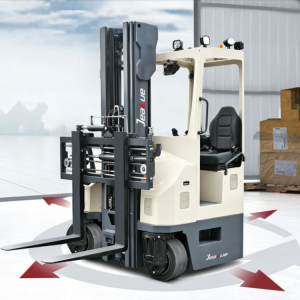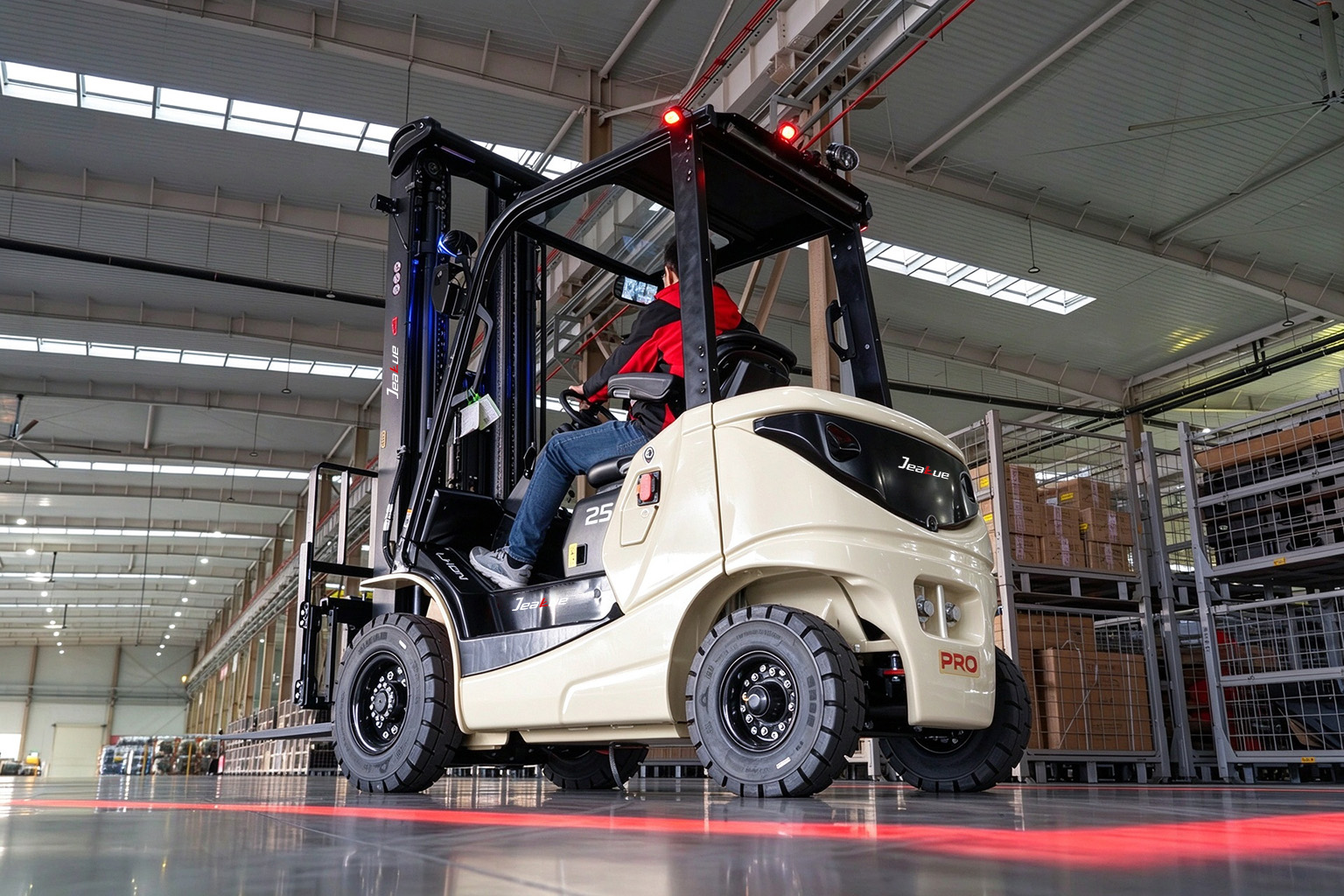
Heavy-duty electric forklifts have long been viewed as the compromise option—quiet and clean, but lacking the raw power of diesel. That perception is rapidly becoming obsolete. With the arrival of high-voltage lithium-ion technology, electric forklifts are now matching diesel performance in the most demanding applications, from ports to steel yards, without the emissions or maintenance headaches.
High-Voltage Architecture Delivers Diesel-Grade Power
The breakthrough behind the latest heavy-duty electric forklifts lies in their voltage. Hyundai’s B-X Series, for instance, operates at 309–348V in its 4–9 tonne models and scales up to 618V in the 10–18 tonne range . Higher voltage means the same power can be delivered at lower current, which reduces heat generation, minimises energy loss, and extends component life . The result is performance that rivals diesel: the 70B-X matches its diesel counterpart exactly on lift speeds (480 mm/s unloaded, 450 mm/s loaded) while achieving a 40% loaded gradeability .
Built for the Harshest Environments
Modern heavy-duty electric forklifts are not fair-weather machines. Key components are rated IP67 or even IP69K, making them waterproof and dustproof for year-round outdoor use . Hyundai’s B-X Series uses liquid cooling and integrated battery heating to maintain optimal performance in extreme cold and heat, with full power available immediately after charging . The trucks have undergone water spray, flooding, and cold-climate endurance testing to prove their reliability .
Fast Charging and Multi-Shift Capability
Range anxiety is fading. The LFP battery technology in these forklifts supports rapid charging up to 120 kW, allowing a full recharge in roughly one hour and up to 11 hours of continuous operation . Opportunity charging during breaks and shift changes keeps multi-shift operations running without battery swaps or overnight downtime . Jungheinrich’s FalcOn prototype demonstrates even faster charging, reaching 80% in around 30 minutes via a CCS-2 interface .
The Economic Case
The higher upfront cost of a heavy-duty electric forklift is offset by dramatically lower running costs. Electricity is significantly cheaper per hour than diesel fuel, and electric drivetrains have far fewer moving parts, reducing maintenance expenses . Hyundai estimates annual savings of up to 70% on fuel and maintenance compared to diesel models, with lifetime savings reaching €73,000 over ten years .
Industries Making the Switch
Sectors historically dependent on diesel are now adopting heavy-duty electric forklifts. Ports, shipbuilding, timber processing, metal production, and construction materials operations are prime candidates . These environments demand high lifting capacities, long operating hours, and resistance to weather—requirements that high-voltage electric trucks now meet without compromise .
The Road Ahead
The electrification of heavy material handling is no longer experimental. With completed product ranges spanning 4 to 18 tonnes and continued advances in charging infrastructure, the heavy-duty electric forklift has arrived as a viable, cost-effective, and sustainable alternative to diesel. For operations seeking to reduce their carbon footprint without sacrificing productivity, the question is no longer whether electric can compete—but how soon they can make the switch.