Introduction
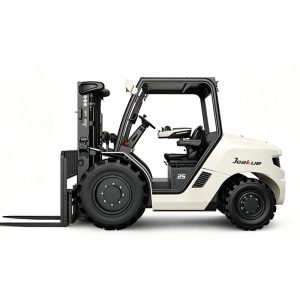
The four-wheel counterbalance forklift is the most widely recognized and utilized type of industrial truck in warehouses, manufacturing plants, and distribution centers worldwide. Distinguished by its two front load-bearing wheels and two rear steering wheels, this configuration offers superior stability compared to its three-wheel counterpart, making it the preferred choice for applications involving heavier loads, outdoor yards, and uneven surfaces. While the basic counterbalance principle—using rear counterweight to offset front loads—has remained unchanged for decades, modern four-wheel models are undergoing a significant transformation driven by lithium-ion battery technology, integrated telematics, and advanced safety systems .
Design and Stability Characteristics
The defining feature of a four-wheel counterbalance forklift is its chassis architecture. Unlike three-wheel models, which use a single steer wheel or dual small wheels for tight maneuvering, four-wheel trucks employ a traditional rear axle with two wheels. This design distributes weight more evenly across all four points, resulting in higher residual capacity at elevated lift heights and greater ride stability on uneven ground . Jungheinrich’s EFG 3 series, for instance, utilizes a high-pivot steering axle that maintains optimal weight distribution even when traversing rough outdoor terrain .
This stability comes at a slight cost to maneuverability. Four-wheel trucks typically have larger turning radii than three-wheel models, making them less suited to very narrow aisles. However, for the vast majority of general warehouse and yard applications—where aisle widths accommodate standard 48-inch pallets and the priority is safe load handling rather than extreme agility—the four-wheel configuration remains the standard . EP Equipment’s CPD20FVL, for example, achieves a 1,730 mm turning radius while maintaining a 2,000 kg load capacity, a balance that suits most manufacturing and storage environments .
Power Trends: The Shift Toward Lithium-Ion
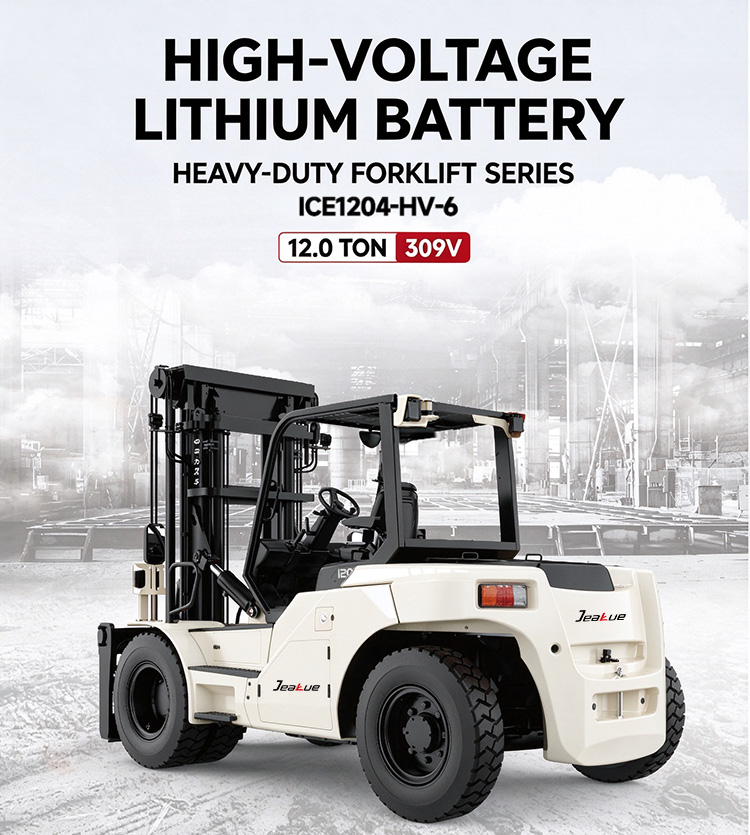
The most significant recent development in four-wheel counterbalance design is the rapid adoption of lithium-ion battery technology, often integrated directly into the chassis rather than as a removable lead-acid block. Yale’s ERC050-060VGL integrates the battery under the operator compartment, freeing floor space and lowering the overall truck weight. This design change improves acceleration and reduces energy consumption, while the battery itself requires zero maintenance and can reach a full charge in just over an hour .
The operational implications are substantial. Traditional lead-acid batteries require dedicated charging rooms, ventilation for off-gassing, and either battery swapping or extended charging downtime between shifts. Integrated lithium-ion systems support “opportunity charging”—plugging in during breaks or between tasks—which allows multi-shift operations without battery changes . For fleet managers, this eliminates the capital expense of spare batteries and the labor associated with swapping them.
Internal combustion models, particularly LPG and diesel, remain relevant for heavy outdoor applications and high-intensity operations where refueling speed is paramount. Toyota’s 8-Series engine-powered four-wheel trucks feature the System of Active Stability (SAS), which monitors load dynamics and locks the rear axle when instability is detected, addressing the tip-over risks inherent to IC-powered counterbalance designs . However, tightening emissions regulations and the improving performance of electric models are steadily eroding the IC segment’s market share, particularly in indoor and mixed-use facilities .
Safety and Operator Assistance Systems
Modern four-wheel counterbalance forklifts incorporate layers of electronic safety assistance that go well beyond the basic hydraulic and mechanical systems of older models. Curve control systems, such as Jungheinrich’s curveCONTROL and Hyundai’s equivalent, automatically reduce travel speed when the steering angle indicates a turn, mitigating lateral tip-over risk—the most common cause of forklift accidents . Toyota’s SAS takes this further by physically locking the rear axle when sensors detect instability, a proactive intervention rather than a simple speed reduction .
Access control and operator presence systems have also become standard. These systems prevent truck movement unless the operator is properly seated and, in some cases, has completed a pre-operational safety checklist. Jungheinrich’s accessCONTROL, for instance, will not unlock the truck until a sequence of safety checks is completed . Load moment indicators, while still optional on many models, are increasingly available to warn operators before they exceed safe capacity at a given lift height—a critical feature given that load capacity decreases as mast height increases.
Operational Efficiency and Total Cost of Ownership
The economic case for four-wheel electric counterbalance trucks has strengthened considerably. Energy recovery during braking, standard on models like the Jungheinrich EFG M series, recovers up to 30 percent of kinetic energy, extending usable runtime per charge . AC drive motors with brushless designs reduce maintenance intervals and improve efficiency compared to older DC systems . Telematics integration, now standard on many new models, provides fleet managers with utilization data, maintenance alerts, and pre-operational check records, enabling data-driven replacement and service decisions .
For operations comparing electric to internal combustion, the calculus increasingly favors electric even in demanding applications. CESAB’s B600 series, for example, is marketed explicitly as an alternative to IC trucks in intensive outdoor applications, with cabin configurations, heating systems, and motor protection rated for harsh environments . The residual capacity and hydraulic power available from modern 80-volt electric systems now support attachments such as clamps, multi-pallet handlers, and rotating forks that were once the exclusive domain of engine-powered trucks.
Conclusion
The four-wheel counterbalance forklift occupies a stable and essential position in the material handling landscape. Its fundamental design—prioritizing stability and load capacity over extreme maneuverability—remains well-matched to the bulk of industrial lifting tasks. What has changed is the technology surrounding that design: lithium-ion power is eliminating the maintenance burden and space requirements of lead-acid batteries, electronic safety systems are actively intervening to prevent accidents rather than merely warning operators, and telematics are turning forklifts into connected assets within managed fleets. For operations seeking a dependable, versatile, and increasingly efficient workhorse, the four-wheel counterbalance forklift remains the benchmark against which other truck types are measured.