Moving a 20-foot length of steel pipe or a bundle of timber with a conventional counterbalance forklift is an exercise in frustration. The load is longer than the aisle is wide, the center of gravity is unpredictable, and every turn risks striking racking or nearby machinery. Side forklifts—also known as side loaders—solve this problem by fundamentally reorienting the relationship between the operator, the machine, and the load. Rather than approaching long materials head-on, a side forklift carries them parallel to the direction of travel, allowing safe transport through narrow aisles and precise placement into cantilever racks or storage bays.
The Core Design Advantage: Lateral Handling
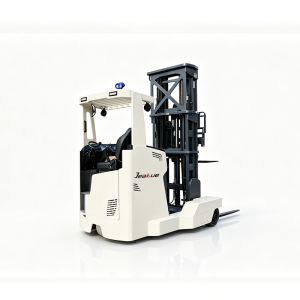
The defining characteristic of a side forklift is its ability to pick up and carry loads from the side of the machine. In a typical configuration, the operator sits in a cabin offset to one side, while the fork carriage and mast assembly travel along a rail or reach mechanism that extends laterally from the chassis . This design allows the forklift to approach a long load that is resting parallel to its path, lift it without rotating the machine, and then retract the load onto a side deck for transport.
This lateral capability is not merely a convenience; it is a safety imperative. When a standard forklift attempts to carry a long load oriented perpendicular to its direction of travel, the load extends far beyond the machine’s footprint, creating a wide, swinging hazard. A side forklift, by contrast, keeps the load within a much narrower envelope, reducing the risk of collisions in confined spaces. Japanese patent documentation on side forklift operations emphasizes this point, describing how the fork assembly extends laterally to retrieve long objects and then retracts slowly under load to prevent the cargo from shifting or toppling during the transition .
Maneuverability in Very Narrow Aisles
The modern side forklift has evolved far beyond a simple lateral-reach mechanism. Machines like the Combilift C-series and the Drexel SL120 combine side-loading capability with multi-directional or rotating-mast designs, allowing them to function as counterbalance trucks, side loaders, and very narrow aisle (VNA) machines in a single unit . The Drexel SL120, for instance, features a front mast that rotates 90 degrees and offers side shift of 44 inches, enabling it to work in aisles as narrow as 72 inches while retaining a capacity of 12,000 pounds at a 24-inch load center .
For operations handling lighter loads, stand-on side loaders such as the Combi-GT prioritize compactness and rapid operator access. With a capacity of 6,000 pounds and four-wheel steering, these machines are designed for environments where the operator needs to move on and off the vehicle frequently, such as busy warehouse bays or sawmill loading areas . The stand-on configuration also improves visibility, a critical factor when negotiating tight turns with a load that may extend several meters beyond the fork tips.
Applications Across Industries
The industries that rely most heavily on side forklifts share a common characteristic: they handle materials whose length makes conventional forklift handling inefficient or dangerous. In the timber sector, side loaders move packs of sawn wood, engineered wood products, and structural timber that may span 6 meters or more. Combilift’s recent introduction of the Combi-FSE 8000, an 8-tonne electric side loader, reflects the growing demand for heavy-duty electric options in timber yards where emissions and noise are concerns . The under-deck battery position and expansive glazing are specifically designed to give operators a clear line of sight when reversing in narrow racking aisles .
The steel and aluminum industries present similar challenges. Long profiles, extrusions, and pipes must be stored in cantilever racks or transported between processing stations without being rotated broadside to the aisle. A side forklift can retrieve a bundle from a rack, retract it onto its deck, and travel lengthwise through the facility, minimizing the aisle width required for transport. Baumann’s EXL series, a purpose-built electric side loader, offers an additional 150 millimeters of reach without increasing the machine’s overall dimensions—a detail that matters when every centimeter of aisle clearance affects storage density .
Building materials distribution represents a third major application area. Drywall sheets, siding panels, and prefabricated components are awkward, damage-prone loads that benefit from the stable, low-profile transport a side loader provides. The ability to carry these materials parallel to the machine’s direction of travel reduces vibration and flexing, which in turn reduces the likelihood of surface damage or structural cracking.
Operational Considerations and Safety Features
Operating a side forklift requires a different skill set than driving a conventional counterbalance truck. The most obvious difference is the operator’s position: seated sideways relative to the direction of travel, the operator must develop a spatial awareness of the load’s extremities and the machine’s swing radius. Modern designs address this through improved visibility and electronic aids. High-visibility three-stage masts, offset operator compartments, and dual joystick controls that consolidate hydraulic functions into intuitive movements are standard on machines like the SL120 .
Load sensing steering and multi-directional wheel positioning further reduce the cognitive burden on the operator. Combilift’s four-way lever positioning allows the wheels to be set for forward, reverse, crab, or spin modes, giving the operator precise control over the machine’s orientation without complex maneuvering . Hydraulic systems with load-sensing pumps deliver power only when needed, improving efficiency and reducing heat buildup during repetitive cycles .
One less visible but critical safety feature is the controlled retraction of the load after pickup. As described in the side forklift patent literature, when the fork carriage retracts toward the chassis under a heavy load, the hydraulic system limits the flow rate to slow the movement as the carriage approaches its stop point . This deceleration prevents the load from shifting forward abruptly, a hazard that could destabilize the machine or damage the cargo.
Choosing the Right Configuration
Prospective buyers face a decision tree defined by load weight, load length, aisle dimensions, and power source. Electric side loaders dominate indoor applications, where emissions and noise are unacceptable, and where battery technology has advanced to the point that shift-long runtimes are achievable. Baumann’s EXL series promises over eight hours of continuous operation per charge, with lithium-ion options available for opportunity charging during breaks . For outdoor yards and heavy timber operations, diesel and LPG models remain prevalent, though the introduction of high-capacity electric models like the Combi-FSE 8000 signals a gradual shift .
Capacity ratings vary widely, from compact stand-on units in the 4,000 to 6,000-pound range to heavy-duty models exceeding 12,000 pounds. Lift heights are equally variable, with three-stage masts reaching beyond 240 inches on some models . The critical specification, however, is often the platform length and the machine’s overall width—dimensions that determine whether a given side loader can actually fit through the aisles and doorways of an existing facility.
Conclusion
The side forklift occupies a specialized niche in material handling, but for industries that routinely move long loads, it is not a luxury—it is a necessity. By reorienting the handling axis from frontal to lateral, these machines transform a task that would otherwise require wide aisles, multiple operators, or risky manual manipulation into a routine, single-operator procedure. As warehouses face pressure to increase storage density and as safety regulations tighten around load handling, the side forklift’s ability to do more in less space will only grow in value.