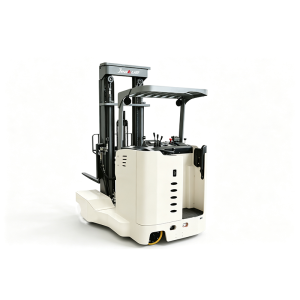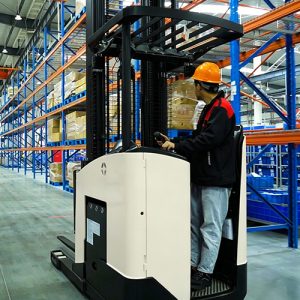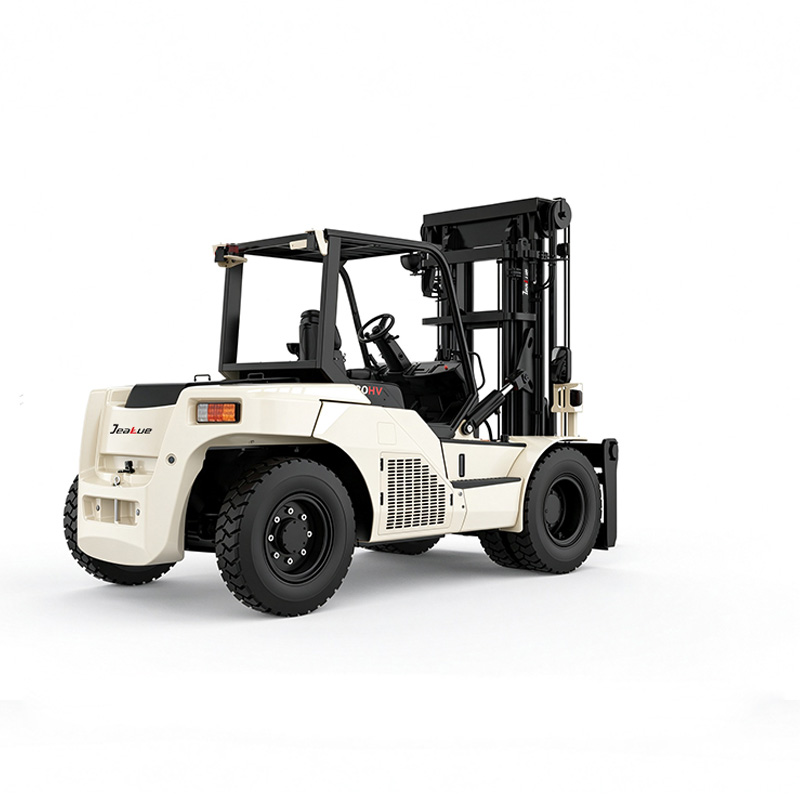
In the modern warehouse, space is a premium commodity. Conventional forklifts, while indispensable for standard pallet handling, often struggle when confronted with long profiles, timber bundles, or oversized loads in narrow aisles. The solution increasingly adopted by forward-thinking operations is the 4-way warehouse forklift—a specialized piece of material handling equipment that combines the functions of a counterbalance truck, a sideloader, and a narrow-aisle reach truck into a single machine.
What Makes a Forklift “4-Way”?
Unlike a traditional forklift that primarily travels forward and backward, a 4-way forklift features a sophisticated steering system that allows its wheels to turn up to 90 degrees . This mechanical flexibility enables the machine to travel not only in the conventional longitudinal direction but also sideways (traversing).
By simply pressing a button or activating a switch, the operator can change the wheel orientation from standard forward/reverse driving to a perpendicular crab-steer mode . This capability means the forklift can approach a rack or a truck bed from the side, pick up a long load, and then transport it down an aisle without ever needing to perform a wide, right-angle turn . For operations dealing with pipes, steel beams, or timber, this eliminates the dangerous and time-consuming practice of maneuvering long loads through tight corners.
The Core Advantage: Space and Safety
The primary driver for investing in 4-way technology is the dramatic increase in storage density. Because these trucks can travel sideways, the aisle width required to handle long loads is reduced to little more than the width of the truck itself . In facilities where every square meter counts, this can translate to a potential storage capacity increase of up to 100% by eliminating the need for expansive turning radii .
Safety is another critical benefit. Carrying a long load at elevated heights while turning is inherently unstable. A 4-way forklift allows the operator to keep the load low—often resting on an integrated platform—while transporting it laterally . This low center of gravity significantly reduces the risk of tipping. Furthermore, the ability to pick and place loads from the side means the operator does not need to blind-reverse or make awkward adjustments in confined spaces, reducing the risk of collision with racking or personnel .
Versatility in Design and Power
The market for 4-way forklifts offers a range of configurations to suit different operational environments.
For indoor warehouses with sensitive goods or clean-air requirements, electric models are available. These machines, such as the Toyota Reflex series, provide quiet, emission-free operation with precise electronic steering and regenerative braking to extend battery life . They are ideal for handling long loads alongside conventional pallet storage in mixed-use facilities.
For heavier industries or mixed indoor/outdoor use, diesel or LPG-powered multi-directional forklifts provide the necessary torque and durability. Heavy-duty models from manufacturers like Combilift or Hubtex can handle capacities ranging from a few tonnes up to 14 tonnes or more, often featuring hydrostatic drive and large pneumatic tires for uneven ground . These machines are frequently seen in steel distribution, aluminum extrusion, and timber yards where loads are not only long but exceptionally heavy.
Key Considerations for Implementation
While the benefits are clear, adopting 4-way forklifts requires a shift in operator mindset and warehouse planning.
-
Operator Training: Driving sideways is counter-intuitive for operators accustomed to standard forklifts. Training is essential to ensure that operators fully utilize the multi-directional capabilities while maintaining awareness of the truck’s wider footprint when the wheels are turned.
-
Aisle Design: To maximize the benefit, warehouses often need to reconfigure racking to create guided aisles. These narrow aisles may be equipped with rail guidance systems that allow the 4-way forklift to operate at high speeds with minimal clearance, further boosting throughput .
-
Attachment Options: Many 4-way forklifts can be equipped with hydraulic fork positioners and telescopic forks. Telescopic forks are particularly useful because they can reach across a trailer bed or rack to pick up a load without the truck needing to enter the tight space .
Conclusion
The 4-way warehouse forklift represents a significant evolution in material handling flexibility. By breaking free from the constraints of forward-only travel, it solves the twin challenges of handling long loads and maximizing storage density. While it may not replace the standard counterbalance truck for every task, for operations burdened by space constraints or cumbersome long goods, the 4-way forklift is not just an alternative—it is often the most efficient and safest tool for the job.