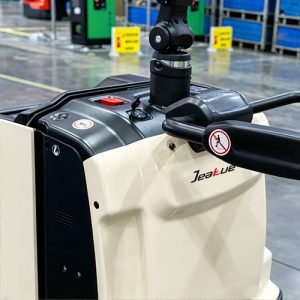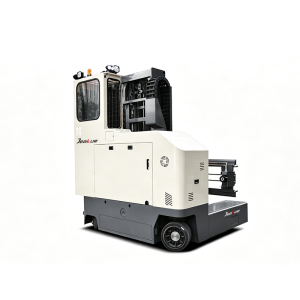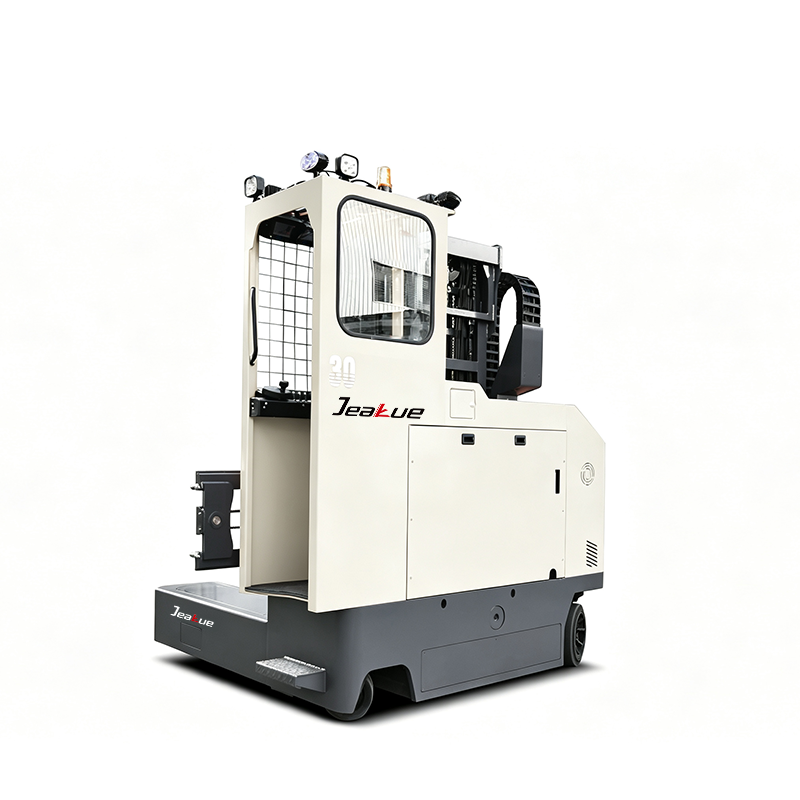
In the fast-paced world of modern logistics, warehouse space is at a premium. As e-commerce continues to boom and supply chains demand ever-greater efficiency, the ability to move goods swiftly and safely within confined indoor environments has become a critical competitive advantage. At the heart of this challenge lies a specialized piece of material handling equipment: the indoor three-wheel forklift.
The Mechanics of Agility
The defining characteristic of a three-wheel forklift is its chassis configuration. Unlike traditional four-wheel models, these machines feature two front drive wheels and a single rear steer wheel. This seemingly simple design change yields profound operational benefits. The single rear wheel allows for a dramatically tighter turning radius—often as low as 1.4 to 1.8 meters—enabling the forklift to pivot almost on its own axis. In practical terms, this means a three-wheel forklift can operate comfortably in aisle widths of 3.0 to 3.4 meters, whereas a four-wheel counterpart would require significantly more space.
For warehouse managers, this agility translates directly into increased storage density. Every centimeter saved in aisle width can be converted into additional racking, maximizing the cubic utilization of a facility. In high-rent urban distribution centers, this spatial efficiency is not merely a convenience—it is an economic necessity.
Indoor Optimization and Stability
While three-wheel forklifts are occasionally used outdoors on paved surfaces, their true domain is the smooth, level concrete floors of indoor warehouses. Their design prioritizes maneuverability over rough-terrain capability, making them ideal for the precise, repetitive tasks of loading, unloading, and racking within a controlled environment.
Concerns regarding stability are addressed through modern engineering. Although the three-wheel design has a smaller footprint, manufacturers have incorporated features such as low centers of gravity, overhead tilt cylinders, and electronic stability systems to ensure safe operation. For instance, Linde’s three-wheel series includes a Curve Assist system that automatically adjusts speed during turns to prevent tipping. These technological interventions mean that, on flat indoor surfaces, a well-designed three-wheel forklift offers stability comparable to larger models for its rated capacity.
Power and Efficiency
The vast majority of indoor three-wheel forklifts are electric, powered by either traditional lead-acid or increasingly prevalent lithium-ion batteries. Electric power is non-negotiable indoors due to zero emissions and significantly lower noise levels, which contributes to a healthier and more pleasant working environment.
Lithium-ion technology has been a particular game-changer. Modern lithium-powered three-wheelers offer fast charging, opportunity charging (topping up during breaks), and maintenance-free operation, eliminating the need for battery swapping or watering. This shift not only reduces downtime but also lowers the total cost of ownership by extending battery life and reducing energy consumption.
Safety and Operator Considerations
Safety remains paramount in any material handling operation. The compact nature of three-wheel forklifts demands skilled operators who understand the machine‘s dynamics. The Ministry of Manpower in Singapore, for example, emphasizes that all forklift operators must undergo proper training and mandatory refresher courses every three years to reinforce safe practices, load chart interpretation, and stability fundamentals.
Operators must adhere to essential safety protocols, including wearing seatbelts, driving within speed limits, slowing down at corners, and never exceeding the forklift’s rated load capacity. Due to the reduced counterweight in the rear, three-wheel forklifts are generally limited to lighter loads—typically up to 2.0 tons—making them best suited for general pallet handling rather than heavy lifting.
Conclusion
The indoor three-wheel forklift represents a focused engineering solution to a specific industrial problem: how to move goods efficiently in tight spaces. By sacrificing outdoor versatility and heavy-lifting brute force, it gains unmatched agility, spatial efficiency, and operational precision. For warehouses, distribution centers, and manufacturing facilities where space is tight and every second counts, the three-wheel forklift is not just an option—it is an essential asset for maintaining competitive advantage.