As warehouse real estate costs climb and product profiles grow more varied, the conventional reach truck is increasingly hitting its limits. The multi-directional reach truck has emerged as a specialized solution for operations that must handle long, bulky, or awkward loads without sacrificing storage density. These machines allow operators to travel forward, sideways, diagonally, and even rotationally, transforming what was once a spatial compromise into a strategic advantage.
The Core Distinction: Steering That Changes the Equation
What separates a multi-directional reach truck from a standard unit is its wheel and steering architecture. Rather than relying solely on rear-wheel steering for conventional forward and reverse travel, these trucks enable independent or synchronized rotation of load wheels and drive wheels. The result is the ability to move laterally down an aisle, eliminating the right-angle turns that demand wider aisles in traditional layouts.
HUBTEX’s NexX model illustrates the engineering behind this capability. Its three-wheel HX steering provides 360-degree rotation, allowing the operator to switch between lengthways, crossways, and circular travel without stopping. The system is fully electric, with no hydraulic components in the steering and traction drive, which reduces energy consumption and maintenance demands. Combilift’s Combi-MR4 takes a different approach with its Dynamic 360° steering, which gives each wheel individual rotation capability. This enables forward, sideward, and crab-steer modes with seamless transitions while the truck is in motion.
Why Long Loads and Narrow Aisles No Longer Conflict
The practical payoff of multi-directional travel is most evident in facilities that handle timber, pipes, extrusions, carpet, or other long goods. In a conventional warehouse, storing a 20-foot length of material typically requires either a wide aisle for turning or a dedicated long-load bay that wastes vertical space. A multi-directional reach truck can carry such loads sideways, keeping the load’s long axis parallel to the racking and reducing the required aisle width dramatically. Toyota notes that its multi-directional model can reduce aisle width by up to 40%.
Capacity figures across manufacturers reflect the range of applications. HUBTEX’s NexX handles up to 6,600 lbs and can transport long goods up to 315 inches in tight spaces, with lift heights reaching 354 inches for high-rack order picking. Combilift’s Combi-MR4 is available in configurations spanning 5,000 to 9,000 lbs, with a notably low platform height of 380 mm that allows otherwise unusable space near the floor to be incorporated into racking systems. Toyota’s offering, the RF1-MD1X45, carries 4,500 lbs and features articulating load wheels for horizontal travel, with a lift height of 268 inches.
Ergonomics and Operator Interface
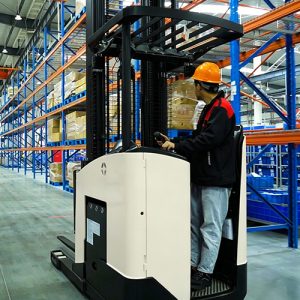
The specialized nature of these trucks places unusual demands on the operator, and manufacturers have responded with cabin designs tailored to multi-directional work. HUBTEX equips the NexX with a transverse seating position, meaning the operator sits perpendicular to the direction of travel. This arrangement provides optimal visibility in both forward and sideways modes without requiring the operator to twist repeatedly. DIMOS takes a similar approach with its Hawk model, citing the crosswise seat cabin as essential for all-round visibility during complex maneuvers.
Control interfaces have likewise evolved. Cat’s NRM20N2 and NRM25N2 models incorporate a Responsive Drive System that adjusts performance parameters based on accelerator and hydraulic control movement, along with progressive steering and curve control to maintain stability during direction changes. Combilift’s multifunction joystick allows the operator to twist the control left or right to adjust wheel positions simultaneously, engaging crab steering without interrupting the work cycle.
Safety and Stability Considerations
Multi-directional travel introduces dynamic forces that differ from conventional forklift operation, particularly when long loads are oriented sideways. Braked load wheels, as fitted to the DIMOS Hawk, help ensure even braking and directional stability when handling long goods. Cat’s system automatically reduces drive and reach speed as mast height increases, and a lift height indicator is standard. Toyota incorporates mode indicator lights and weight sensors to assist the operator in monitoring travel direction and load status.
The Bottom Line
The multi-directional reach truck is not a universal replacement for every warehouse forklift. It is a targeted answer to a specific and costly problem: how to store and move long or bulky loads without dedicating excessive floor space to maneuvering clearance. For operations in timber, building materials, metal fabrication, or any environment where aisle width is the binding constraint on storage density, these machines offer a way to reclaim capacity that conventional equipment cannot reach. As warehouse space becomes scarcer and product profiles more diverse, the ability to travel sideways may prove less of a niche feature and more of a baseline expectation.