In the modern material handling landscape, the trend is clear: efficiency is no longer just about raw power, but about precision, maneuverability, and environmental responsibility. As warehouses become denser and retail spaces demand just-in-time delivery, the need for equipment that can operate in shrinking footprints has skyrocketed. Enter the 0.8-ton compact electric forklift—exemplified by models like the FBS08.
While “FBS08” often serves as a generic model designation for an 800kg (0.8 ton) capacity 3-wheel electric forklift, the specifications associated with this class of machine reveal a marvel of engineering balance. It is not merely a downsized forklift; it is a specialized tool designed to deliver maximum output where larger machines simply cannot tread.
Engineering a Smaller Footprint
The most striking feature of the FBS08 class is its physical economy. In an industry where the “1-ton” models are often considered entry-level, the 0.8-ton variant shaves off critical inches that make all the difference in congested environments.
Data from various manufacturers show that these compact units generally feature an overall width ranging from approximately 860mm to 944mm . To put that into perspective, a standard pallet is 1200mm wide. This narrow chassis allows the FBS08 to slip through warehouse racking and trailer doorways that would scrape the sides of a standard forklift.
Furthermore, the three-wheel design (often configured with two front drive wheels and one rear steering wheel) provides a turning radius that competitors with four wheels struggle to match. Depending on the specific variant and tire choice, the FBS08 can achieve an outside turning radius as tight as 1330mm to 1560mm . This agility allows operators to perform 90-degree turns in aisles that are less than 3 meters wide, effectively increasing storage density without expanding the building footprint.
The 800kg Threshold: Right-Sizing for Efficiency
One of the biggest inefficiencies in logistics is using a 5-ton forklift to move a 500kg load. The FBS08 addresses this head-on with a rated capacity of 800 kg (approx. 1,760 lbs) at a 400mm or 500mm load center .
This capacity is specifically calibrated for the most common material handling tasks:
-
Parcel and courier handling: Moving palletized boxes and mail bags.
-
Retail backrooms: Lifting consumer electronics, appliances, or bulk goods.
-
Light manufacturing: Feeding assembly lines with raw materials or removing finished parts bins.
It occupies the “Goldilocks” zone of warehousing—powerful enough to handle substantial weight, yet light enough to operate on mezzanine floors or in freight elevators. Some variants even offer foldable forks, allowing the unit to be transported in a passenger elevator to service multi-floor storage areas .
The Electric and Lithium Advantage
Modern FBS08 models have largely moved away from internal combustion, embracing electric powertrains. The industry shift toward Lithium-ion batteries has transformed the capabilities of this compact class .
Historically, lead-acid batteries required lengthy charging times, ventilation for off-gassing, and battery swapping equipment—challenges that negated the benefits of a small truck. However, the current generation of the FBS08 offers:
-
Opportunity Charging: Lithium batteries can be topped up during driver breaks without damaging the cells.
-
No Maintenance: No watering or acid cleaning required.
-
Stable Voltage: The 24V to 48V systems provide consistent power delivery, ensuring that the 800kg capacity is available even when the battery gauge reads low .
Manufacturers like HELI report that these lithium-powered H4 series models are ideal for “floor-sensitive” operations, meaning their low ground pressure and smooth acceleration protect delicate flooring surfaces often found in showrooms or modern automated warehouses .
Precision in Motion: Speed and Control
Do not let the “mini” size fool you regarding performance. The electric motors in the FBS08 provide instant torque. Specifications show travel speeds typically ranging from 8 km/h to 14 km/h when loaded and 10 km/h to 12 km/h unloaded .
However, the real capability lies in the “creep” speed and hydraulic control. The lifting motors (often rated between 2.2kW and 4kW) allow for millimeter-precise lowering and raising, crucial for handling fragile goods or stacking to specific heights of up to 3 meters or 4.5 meters on high-mast variants . The multi-stage mast options allow the truck to collapse to a transport height of roughly 2 meters while extending to nearly double that for racking .
The Ergonomic Payoff
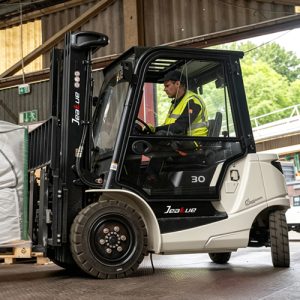
Finally, the capabilities of the FBS08 extend to the operator. Unlike older “walkie” stackers that require the user to walk behind the unit, the FBS08 is a sit-down counterbalance truck. Even within a total length of roughly 2.3 meters, engineers have carved out a comfortable operator compartment .
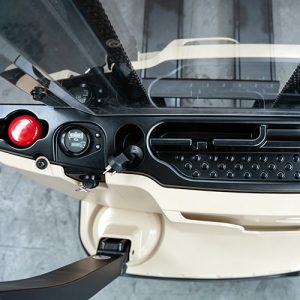
Features such as fully enclosed cabs, hydraulic power steering, and intuitive control panels reduce fatigue. When an operator is less tired, they are faster and safer. In a compact machine where the operator is often working in high-traffic areas, this ergonomic focus is a critical safety capability.
Conclusion
The 0.8 Ton FBS08 model proves that good things come in small packages. It is a masterclass in mechanical efficiency—prioritizing maneuverability over brute mass, right-sizing over overkill, and clean electric power over fossil fuels.
For the small-to-medium enterprise looking to modernize their fleet, or the large distributor needing to optimize the last mile of the warehouse, the FBS08 offers a compelling value proposition: It fits where others can’t, it lifts what you need it to, and it does so quietly, cleanly, and precisely.