Customer profile
The customer is a large UK builder’s merchant, operating 38 branches nationwide and managing a fleet of approximately 180 counterbalance forklifts. Their operations involve demanding outdoor and mixed-use environments, typical of builder’s merchant yards across the UK.
The challenge
Historically, the customer relied on diesel counterbalance forklifts across their network. While robust, these trucks came with increasing challenges:
Rising running and fuel costs
Ongoing maintenance requirements
Pressure to modernise fleet operations and reduce reliance on fossil fuels
With a large, distributed fleet and high utilisation across multiple branches, the customer began exploring alternatives that could reduce operating costs without compromising performance in tough yard conditions.
The solution: JK EFL Series lithium forklifts
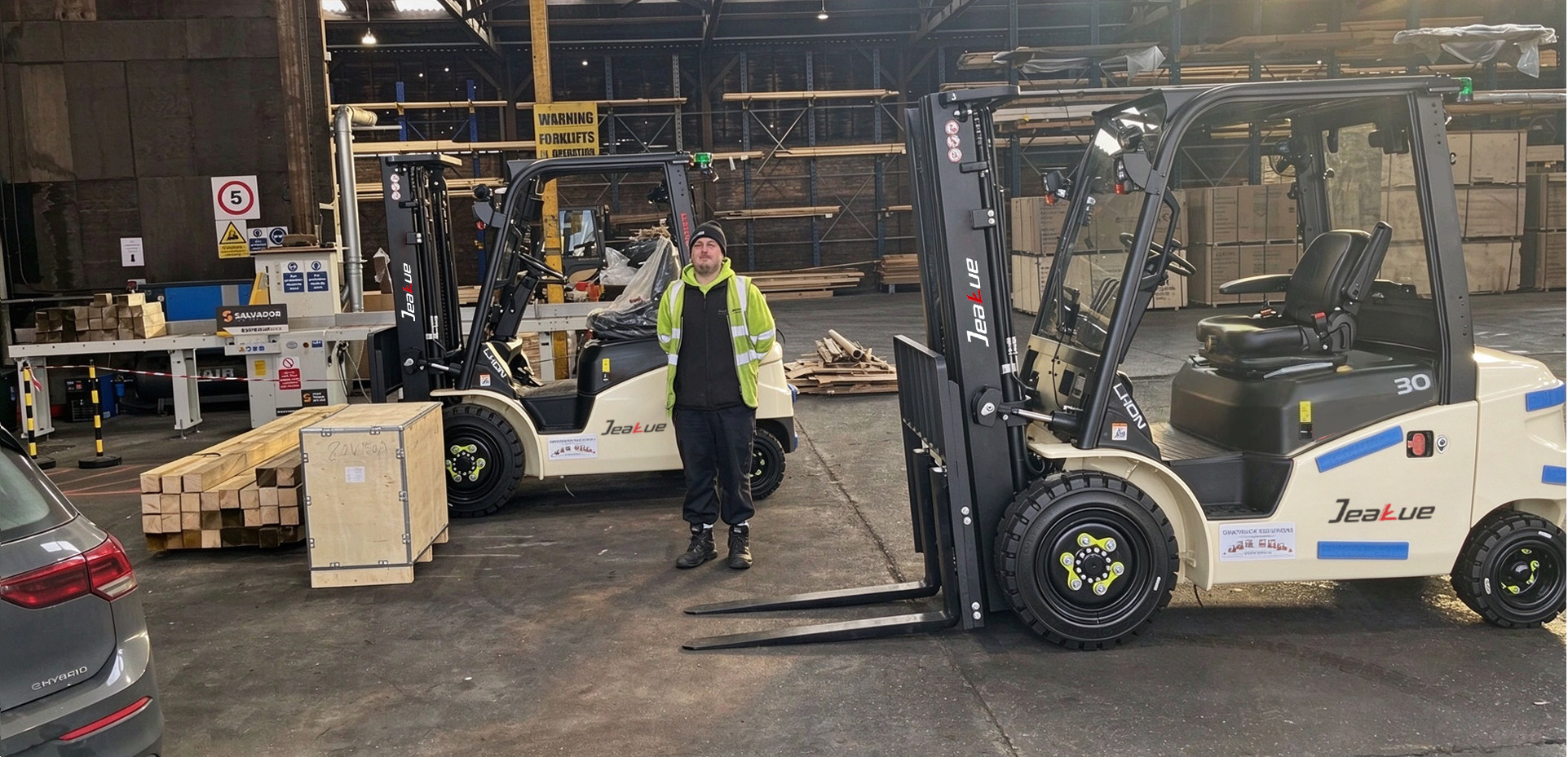
After evaluation, the customer selected JK FBL Series lithium counterbalance forklifts, starting with an initial delivery of 2 trucks, as part of a wider planned rollout.
The FBL Series proved to be a strong fit for builder’s merchant applications due to:
A compact 3.0-ton design, ideal for branch-level operations
Long battery life suited to daily yard use
Low maintenance requirements compared to diesel trucks
A design built like a traditional yard truck, capable of handling outdoor environments while delivering the benefits of lithium power
This combination allowed the customer to transition to electric without sacrificing durability or usability.
Safety-driven specification
Safety was a key consideration for the customer, who operates under strict site safety rules across all branches.
The trucks were specified with:
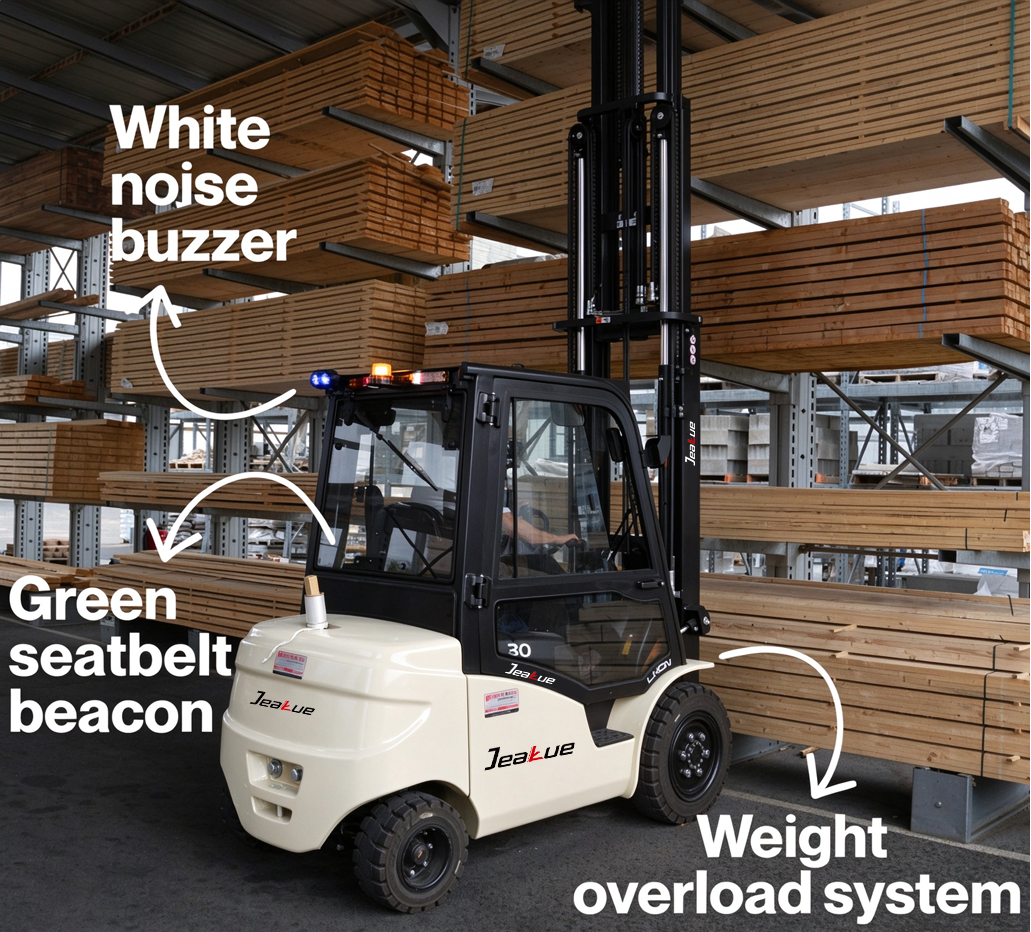
A weight overload system to prevent unsafe lifting
A green seatbelt beacon, reinforcing operator compliance
Additional features such as reduced noise levels and smooth operation, contributing to a safer working environment
These features are increasingly becoming standard expectations in large merchant yards, with customers now also requesting options such as white noise alarms for forward and reverse travel.
Cost savings and efficiency
One of the main drivers for the switch was cost.
At a high level, the customer is achieving savings of over £7,000 per truck per year when compared with diesel equivalents.
These savings are driven primarily by:
The significant cost difference between diesel fuel and electricity
Reduced servicing and maintenance requirements
Lower downtime and simplified daily operation
Over the life of a forklift, these savings quickly scale across a large fleet.
Fleet rollout strategy
The initial delivery forms part of a rolling replacement programme, with plans to replace 8–10 trucks per year until the entire fleet transitions to electric.
This phased approach allows the customer to:
Manage capital investment effectively
Standardise specifications across branches
Gradually eliminate diesel trucks from their operation
Early feedback
Early operational feedback has been very positive, with operators highlighting:
Lower noise and vibration
A smooth, comfortable drive
Practical features such as USB ports, sun visors, and fast charging times
These usability improvements help support operator acceptance and long-term adoption across the fleet.
Industry perspective
As Dave Fellows, Area Sales Manager at Forktruck Solutions Ltd, explains:
“Switching from fossil fuels to electric can save a customer thousands over the life of a forklift, while also significantly reducing their carbon footprint.”