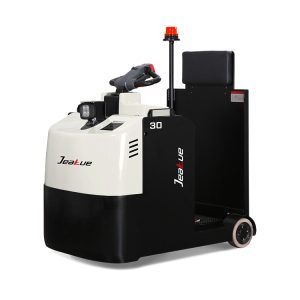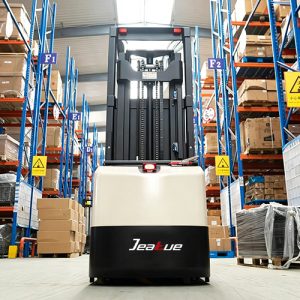
Warehouses are under constant pressure to fit more inventory into less space. The narrow aisle three wheel forklift has emerged as a practical solution, combining the agility of a compact electric truck with the lifting power of a counterbalance machine. Its distinctive reverse-tricycle design—two front wheels and a single rear drive wheel—transforms tight warehouse layouts into workable operational zones.
A Matter of Geometry
The defining feature of a three wheel forklift is its steering geometry. With one rear wheel handling both drive and steering functions, the truck pivots around a point much closer to its center than a conventional four-wheel model . This creates a dramatically tighter turning radius, allowing the forklift to maneuver in aisles where a standard counterbalance truck would scrape racking on both sides.
Industry guidelines classify a narrow aisle as measuring between 8.5 and 10.5 feet wide . Standard counterbalance forklifts typically need at least 10.5 feet to turn comfortably. The three wheel electric forklift, however, operates effectively within that narrower range, enabling warehouses to add racking where a four-wheel truck would require turning clearance.
For operations pushing density even further, articulated three wheel models take the concept to its logical extreme. The Bendi B3/30AC, for example, works in aisles as narrow as 72 inches—just six feet—by combining a three-wheel chassis with 220-degree front-end articulation . This design blurs the line between counterbalance forklifts and purpose-built narrow aisle equipment.
Where It Excels
The three wheel forklift performs best on smooth, level indoor surfaces, which describes the majority of modern warehouse floors . In these environments, the single rear wheel provides handling that feels almost intuitive, with the truck pivoting in ways that larger equipment cannot match.
Lift capacities typically range up to 4,000 pounds, sufficient for the vast majority of palletized goods in distribution and retail warehousing . This capacity ceiling reflects the trade-off inherent in the design: the three-wheel configuration prioritizes maneuverability over the heavy lifting capabilities of four-wheel counterbalance trucks, which can handle loads exceeding 10,000 pounds.
Beyond basic put-away and retrieval, these trucks offer practical advantages in mixed-use facilities. A three wheel electric forklift can transition from narrow storage aisles to loading docks and trailer interiors, handling tasks that might otherwise require two different types of equipment . This versatility reduces fleet complexity and simplifies operator training.
Operational Considerations
The single rear wheel that gives the three wheel forklift its agility also defines its limitations. On uneven surfaces or ramps, the three-point stance can feel less planted than a four-wheel truck, particularly when carrying a load . Operators must exercise additional caution when cornering, as the truck’s stability envelope is narrower than that of its four-wheel counterpart.
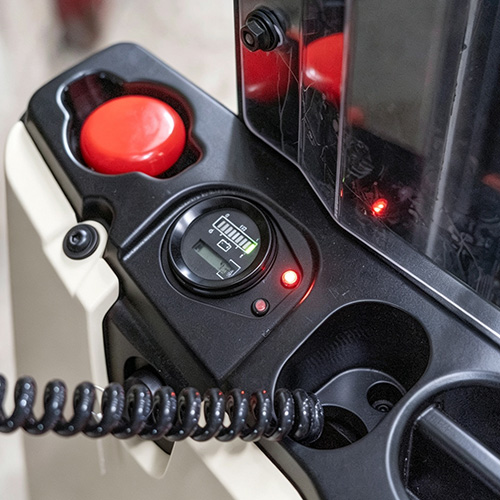
Modern electric models mitigate these concerns through sophisticated control systems. Mast and travel interlocks, for instance, automatically disable hydraulic and drive functions when the operator leaves the seat . Regenerative braking captures kinetic energy during deceleration, reducing brake wear while providing more controlled stopping. Slope speed control maintains consistent descent speeds on ramps, preventing the runaway acceleration that can occur with a heavy load on an incline.
Battery technology has also evolved to support intensive daily use. Lithium-ion options offer faster charging and better cold-weather performance than traditional lead-acid batteries, making three wheel electric forklifts viable in refrigerated warehouses and freezers .
A Tool for the Right Space
The narrow aisle three wheel forklift is not a universal replacement for larger counterbalance trucks. Its load ceiling and stability characteristics make it unsuitable for heavy outdoor applications or severely uneven surfaces. But within its intended domain—the dense, smooth-floored warehouse where every square foot of storage counts—it offers a compelling combination of agility, efficiency, and operational flexibility that four-wheel trucks simply cannot match.
For warehouse operators weighing the cost of racking against the cost of equipment, the three wheel forklift often tips the balance toward denser storage. The truck’s tighter turning radius translates directly into more racking positions per square foot, a calculation that becomes increasingly favorable as real estate costs rise and inventory volumes grow.