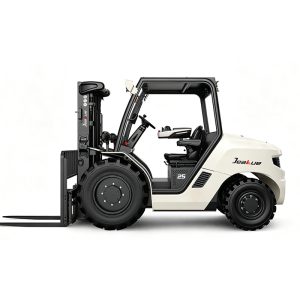
In warehouses and industrial facilities where long loads such as timber, steel profiles, pipes, and extruded materials must be handled, the electric four-way sideloader has become an indispensable piece of equipment. Unlike conventional counterbalance forklifts, this specialized material handling vehicle is designed to carry loads longitudinally on a platform while allowing the operator to travel in multiple directions, making it particularly effective in narrow aisles and confined spaces.
What Is an Electric Four-Way Sideloader?
An electric four-way sideloader is a battery-powered forklift equipped with multidirectional steering capabilities. Also referred to as a four-way forklift or multidirectional sideloader, this vehicle can travel in longitudinal, transverse, diagonal, and circular directions, giving operators exceptional maneuverability in tight warehouse environments. The term “four-way” refers specifically to this four-directional travel capability, which distinguishes it from conventional sideloaders that primarily travel forward and backward with the load on the side deck.
The defining characteristic of a sideloader is its load handling orientation: rather than lifting loads in front of the operator, the load rests on a platform or deck running along the side of the vehicle. This design allows the operator to face the direction of travel with an unobstructed view, while the load remains secure at the side.
The Electric Advantage
The shift toward electric power in sideloader design reflects broader trends in material handling. Electric four-way sideloaders offer several compelling advantages over diesel or LPG-powered alternatives. Most significantly, they produce zero tailpipe emissions, making them ideal for indoor warehouse operations where air quality and ventilation are concerns. They also operate much more quietly than internal combustion engine models, contributing to a safer and more comfortable working environment.
From an operational cost perspective, electric sideloaders typically have lower running costs. Electricity is generally cheaper than diesel or LPG fuel, and electric motors have fewer moving parts, reducing maintenance requirements over the vehicle’s lifecycle. Modern lithium-ion battery technology has largely addressed historical concerns about charging times and range, with opportunity charging during breaks becoming a common practice in multi-shift operations.
HUBTEX, a leading manufacturer in this segment, positions its MaxX electric multidirectional sideloader as a direct alternative to diesel and gas vehicles, emphasizing its suitability for combined indoor and outdoor use.
Why Choose a Four-Way Sideloader?
The primary rationale for selecting a four-way sideloader over a conventional counterbalance forklift relates to the fundamental challenge of handling long loads. When a counterbalance forklift travels with a long load raised in front of it, the load’s weight is concentrated at the fork tips, creating significant stability risks and making it difficult to navigate through doorways or narrow aisles.
A four-way sideloader solves this problem by carrying the load on a stable, flat platform rather than suspended on forks. This approach offers several benefits: the forks and mast experience less wear and tear, the load itself remains unstressed and undistorted during transport, and the operator has a clear view of where the load ends. In terms of space efficiency, sideloaders can reduce required aisle widths dramatically—some configurations can operate in aisles as narrow as 1.65 meters, potentially reducing warehouse space requirements by up to 45%.
The four-way steering capability adds another dimension of flexibility. Operators can switch between longitudinal, transverse, diagonal, and circular travel patterns, enabling efficient navigation in complex warehouse layouts and precise positioning during load pick-up and deposit.
Key Applications
Electric four-way sideloaders are particularly well-suited to industries handling long, bulky, or awkward loads. HUBTEX identifies typical applications including long goods, stacks of metal sheets, chipboard, tools, cable drums, rollers, oversized pallets, and round bars in narrow-aisle rack systems. The timber and steel industries were among the earliest adopters of sideloader technology, and these sectors continue to rely heavily on these vehicles for their combination of safety, efficiency, and load protection.
The vehicles are equally at home indoors and outdoors, provided ground conditions are reasonable. Models with elastic tires and adequate ground clearance can transition between warehouse floors and paved outdoor yards, making them versatile assets for facilities with mixed operations.
Recent Developments and Innovations
The electric four-way sideloader segment continues to evolve, with manufacturers introducing new capabilities and higher-capacity models. Combilift recently launched the Combi-FSE 8000, an 8-tonne capacity four-wheel electric sideloader designed for heavy-duty applications in timber, steel, and other long-load industries. This model features independent traction control with two 18kW drive motors and an under-deck rear battery configuration that improves both visibility and balance.
Safety systems have also advanced considerably. Baumann has developed its SafeLoad Assistance system, which uses sensors within the chassis to calculate stability limits in real time. The system can warn operators when approaching unsafe conditions and, in its Active+ configuration, inhibit functions to prevent tipping or overload situations. This represents a significant step forward in reducing accidents and associated costs.
Autonomous operation is emerging as the next frontier. Combilift’s Combi-AGT is described as the world’s first autonomous four-wheel sideloader, capable of operating in guided aisles and free-roaming environments. Equipped with laser sensors, load detection, and intelligent path planning, it can handle repetitive tasks autonomously while retaining a manual driving option.
Conclusion
The electric four-way sideloader represents a specialized but essential solution for operations that regularly handle long loads. Its combination of multidirectional maneuverability, space efficiency, load stability, and zero-emission operation makes it a compelling choice for warehouses and industrial facilities where conventional forklifts would struggle. As battery technology continues to improve and manufacturers introduce higher-capacity and increasingly automated models, the electric four-way sideloader is positioned to play an expanding role in modern material handling operations.